Zebra rock found by NASA may reveal new clues about Mars geology |
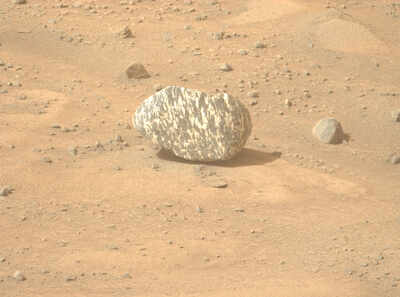
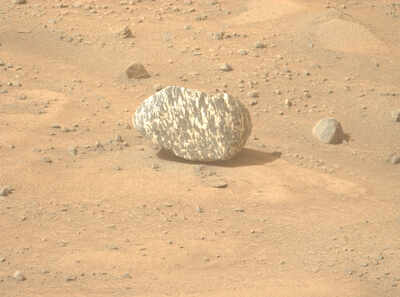
Scientists working with NASA’s Perseverance rover reported an unusual striped rock discovered on the slopes of Jezero Crater, drawing attention from researchers and the public alike. The rover identified the black and white banded stone during its gradual climb toward the crater rim, where it is searching for ancient rocks that may shed light on early Martian history. The rock, informally named Freya Castle, appears unlike previously documented material in the region. Early imaging suggests a distinctive texture that could point to complex geological processes. Although detailed chemical data are still limited, mission scientists say the find highlights the increasing diversity of rocks encountered as Perseverance approaches higher ground near the rim.
Zebra rock stands out against familiar Martian terrain
Freya Castle was first noticed in low resolution navigation images as the rover crossed relatively plain, pebbled ground. At a distance, team members detected hints of an unusual surface pattern. A closer look using Mastcam Z confirmed alternating black and white stripes across a stone roughly 20 centimetres wide.The pattern is not typical of rocks previously studied in Jezero Crater. Images released after the rover had already moved on showed clear banding, quickly prompting discussion online. Some observers compared it to zebra stone on Earth. The science team has been more cautious, noting that visual similarities do not confirm origin.
Igneous or metamorphic processes may explain the banding
Researchers believe the stripes could be linked to igneous or possibly metamorphic activity. On Earth, such banding can form when minerals separate under heat and pressure, or when molten rock cools in stages. Whether similar processes occurred on Mars remains under study.Freya Castle appears to be a loose cobble rather than part of the underlying bedrock. That detail matters. It suggests the rock may have travelled from another location, possibly rolling downhill from higher up the crater rim. If so, its source could still lie ahead on the rover’s route.
Climb toward crater rim reveals growing geological diversity
Since beginning its ascent, Perseverance has encountered a broader mix of rocks. Boulders near an area known as Mount Washburn show varied shapes and textures. Scientists suspect some of these materials may have been uplifted during the ancient impact that formed Jezero Crater.The higher terrain could expose deeper crustal rocks, offering insight into Mars’s early crust and volcanic history. For now, Freya Castle remains a single sample observed from a distance. The rover continues its steady climb. Further discoveries may depend on what lies just beyond the next ridge.