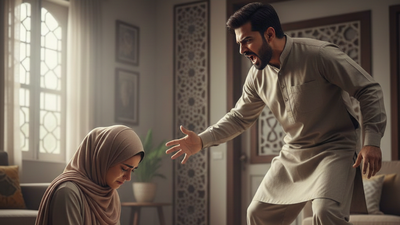
Instant triple talaq isn’t some abstract religious custom — it’s a brutal power play that shatters lives in seconds. A husband utters three words, and a woman loses her home, income, and future. “Some marriages are 6 months old, but some are also 10 years old. It all ended in a moment,” says Nazreen Ansari, national president of Muslim Mahila Foundation. “In one instance, a husband living in Saudi Arabia divorced his wife through an email message. The woman was uneducated and helpless — she had no means of seeking justice.”When a marriage ends impulsively, women bear the full blow. Joint accounts freeze, bills mount, and “adjusting” becomes code for suffering silently to avoid scandal. Even with adult children or parents, support often evaporates. Priyanka Sharma, counselor at Shanti Sahyog, shares: “Who bears the blow of impulsive actions? The woman does. The man can break away, but her family may refuse to remarry her.”The real question isn’t “What does the law say?”—it’s “Where will she go?” and “Who will pay?” This isn’t courtroom theater; it’s a doorstep disaster. Picture a ration list slashed, a landlord pounding for rent, school fees piling up unpaid, and a phone buzzing with sympathy laced with judgment. At the centre of the churn is a simple idea that India has still not made emotionally uncomplicated: maintenance is not charity. It is the legal recognition that unpaid labour, shared households, and dependent lives do not disappear the moment a husband says the marriage is over.Yet time and again, a woman’s survival claim—food, rent, medicines, children’s fees—has been recast as a political dispute about identity, community autonomy and the state’s limits.The topic has forever garnered public attention, but with the release of the movie ‘Haq’, this discourse has yet again found its way to the people’s domain.
A doorstep economy, not a court debate
In separation and divorce, the loss is immediate and material.Women in such disputes often describe a sudden stop in cash flow. The joint account that becomes inaccessible, the monthly expenses that remain stubbornly monthly, and the social pressure to “adjust” because litigation is seen as a public scandal.Even when adult children exist, they are not always economically stable; even when parents exist, they are not always willing or able to take a daughter back.“I remember one case where a woman faced triple talaq in anger. Her husband said it impulsively. Later, her parents insisted she reconcile, but she had suffered a lot. In such cases, women endure the most. They’re pressured by society and family alike,” Priyanka recalls.For many, the marital home is not just a place—it is the only affordable roof.“Who bears the blow of impulsive actions? The woman does, of course. The man in the relationship can break away from the marriage, but in many cases, the girl’s family do not even want her to get married to someone else,” explains Priyanka Sharma, counsellor and community mobiliser at Shanti Sahyog.While some families insist their daughters to reconcile, in other cases, the husband himself has a change of heart. Ansari shares the scenario for women who have to remarry their husbands.“If he later regrets it and wishes to return, the practice of halala becomes another form of exploitation for women,” Nazreen says.She further goes on to elaborate on the other side of the case.“Even after a marriage is ended completely, for how long can the woman sustain herself? Or for how long can her parents look after her and her kids?” Nazreen questions the fate of women who are then left with an uncertain future.That is why maintenance matters. For the woman who has not been earning, or earns too little to restart life overnight, maintenance is what stands between dignity and destitution.The politics begins when this basic safety net is framed not as a welfare-like protection in a modern republic but as an intrusion into personal law.
The conflict
Both Nazreen Ansari and Priyanka Sharma have had encounters with cases of women who had to go through triple talaq. Many cases came after the divorce; however, many also came before the divorce.“We first ask the women what they want—whether they wish to continue living with their families or not. Then, we call both parties for counselling sessions. Many families reconcile and continue living together after such sessions,” Sharma says, “If reconciliation fails, the cases are referred to CAW Cells or legal authorities for divorce proceedings.”Nazreen shares two cases she saw. “In the first case, a woman I knew personally was expecting her first child when her husband stopped speaking to her. His family pressured him to divorce her,” she says.“We intervened and guided her to approach the family court. Over time, the couple reconciled and is now living happily with two children — a son and a daughter,” Ansari shared the story of reconciliation.“In the second case,” she adds, “a woman who was abandoned by her husband had no means to support herself or her child.”In those cases, Ansari’s NGO help women counsel and guide them to get back on their feet.“Initially, she depended on her parents, but that wasn’t sustainable. We counselled her and helped her set up a small shop. Today, she is financially independent and raising her child on her own.”
Why Section 125 became a flashpoint
In the Indian legal system, Section 144 of the Bharatiya Nagarik Suraksha Sanhita (BNSS), earlier Section 125 of the Criminal Procedure Code, has often been described in plain terms as an anti-destitution measure. It is meant to prevent dependents—wives, children, parents—from being left without support.Its logic is secular: the state steps in so that private abandonment does not become public poverty.But when women from religious minorities invoke a provision that looks “uniform” in its application, the argument quickly leaves the home and enters the arena of identity. Critics see it as the state imposing a one-size-fits-all morality; supporters see it as the state finally doing what it is supposed to do—protect vulnerable citizens regardless of faith.The woman, meanwhile, is usually asking for something less philosophical. She asks for a sum that can keep a family afloat.
Shah Bano : One woman, many anxieties
The Shah Bano case became the national turning point because it placed these questions under the harshest light.Shah Bano Begum, an elderly divorced Muslim woman, sought maintenance under Section 125 of the Code of Criminal Procedure. The dispute moved through the courts until it reached the Supreme Court, which ruled in her favour—affirming, in effect, that a religion-neutral maintenance provision could apply and that the prevention of destitution was a constitutional and civic concern.The verdict did more than decide one case. It signalled that the language of equality and welfare could reach into domains governed by religious personal law.For many women’s rights advocates, it looked like overdue justice. For many within the community, it felt like a warning bell: if the state can do this on maintenance, what comes next?Those “what next” anxieties—never purely legal, always political—helped convert a maintenance dispute into a referendum on minority identity and state power.
How politics diluted the judgment
The backlash to Shah Bano was swift and loud.Protests, public mobilisation and political messaging turned the case into a pressure test for the government of the day: stand by a court’s expansive reading of women’s protection, or defuse community anger by narrowing the verdict’s effect.Parliament’s response—the Muslim Women (Protection of Rights on Divorce) Act, 1986—was widely read by critics as a rollback that diluted the Supreme Court’s reasoning. Supporters defended it as necessary to respect Muslim personal law.Courts, over time, tried to interpret the law in ways that did not abandon the goal of preventing destitution.But the damage to the larger idea was already done. It told the country that even the highest court’s gender-justice moment could be politically “managed” into something smaller.
Triple talaq: When a word becomes a weapon
Decades after Shah Bano, the conversation returned through a different door: instant triple talaq—talaq pronounced thrice in one sitting, treated by some as an immediate end to marriage. For women, the complaint was not abstract theology; it was lived harm.A marriage could be terminated abruptly, often without due process, without meaningful negotiation, and with the woman suddenly pushed into economic and social free fall.The moral and political arguments split predictably. Reformers called it arbitrary and cruel. Defenders warned against state interference and majoritarian impulses. But again, the practical issue was urgent: in many cases, the instantness of the divorce multiplied vulnerability—especially where women had limited income, limited family support, and limited access to legal help.
What changed, and when
Legal change came in two steps.First, in 2017, the Supreme Court set aside instant triple talaq, holding that it could not survive constitutional scrutiny in the form it was being defended. In plain terms, the practice was invalidated: a pronouncement could not, by itself, instantly snap a marriage in a way that left women without protection.Second, in 2019, Parliament enacted a law that made the pronouncement of instant triple talaq void and illegal, adding criminal penalties.This is where a new—and politically charged—question emerged.Should a civil vulnerability be addressed through criminal law?Supporters argued that strong deterrence was necessary because women had been ignored for too long. Critics argued that criminalisation could create fresh risks. It could harden family conflict, it could be misused, and it could complicate the very maintenance and support women need by pushing the husband into the criminal justice system.
The unresolved ‘what now’
The law on paper is only the beginning. The lived reality depends on access: whether a woman can find a lawyer, whether she can afford repeated court dates, whether the police station feels like protection or intimidation, whether family pressure forces an out-of-court settlement that leaves her short-changed, and whether a maintenance order is actually enforced.Politically, personal law reform remains high-voltage.Every intervention is interpreted through partisan lenses. Every verdict is packaged into slogans. And every woman who steps into the system is quietly asked to carry the weight of a national argument she did not start.
Back to the doorstep
The country’s big debates—personal law, religious law, minority rights—often arrive at a woman’s home in small, sharp ways: the neighbour’s whisper, the relative’s ultimatum, the landlord’s deadline.The question she lives with is not whether India will one day have uniform family law. It is whether her children will stay in school, whether she can afford medicine, and whether she has a bed to sleep on next month.In India’s personal-law battles, the loudest slogans are rarely the ones that keep a woman housed.