When cosmic relationships turn toxic: How some stars feed on their companions

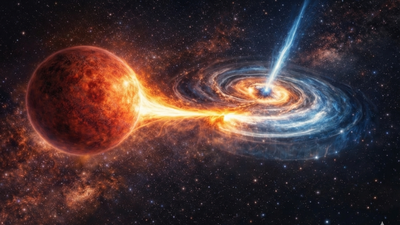
We often blame our stars for the relationships that do not go as planned. Instead of enriching our lives, some connections drain us, leave us worn out, or slip into unhealthy codependency where one partner gives far more than the other. When things fall apart, we look for reasons beyond ourselves. A bad breakup becomes Mercury in retrograde. A toxic encounter is explained away as bad timing or the wrong alignment.The universe, however, holds an unexpected truth. The stars themselves are not immune to destructive or toxic cosmic relationships. Not every cosmic relationship is healthy, and literally Out in space, many stars do not live alone. They exist in tightly bound partnerships, locked together by gravity for millions or even billions of years. Some of these stellar relationships are stable and balanced. Others are anything but. In certain systems, one star slowly feeds on its companion, pulling away gas and energy over time. These interactions, shaped by imbalance and dependence, mirror dynamics that feel uncomfortably familiar here on Earth. And sometimes, when that cosmic codependency goes too far, the consequences are explosive.These systems are shaped by imbalance. One star becomes denser and more dominant, while its companion steadily loses mass. Astronomers study these interactions because they reveal how stars behave under extreme conditions and how stellar systems can turn violent over time.About 200 light years from Earth lies EX Hydrae, a binary system that captures this idea of cosmic codependency. It consists of a white dwarf, the dense remnant of a star like our Sun, and a main sequence companion. The white dwarf’s gravity draws gas away from its partner. As this material spirals inward, it heats up and releases powerful energy.
What is a White Dwarf?
According to Nasa, a white dwarf is the dense, compact remnant left behind when a star like our Sun exhausts its nuclear fuel. After a star has burned all the hydrogen in its core, it expands into a red giant and eventually sheds its outer layers, leaving only the hot core. Despite being roughly the size of Earth, a white dwarf can contain a mass similar to the Sun, making it incredibly dense, so much so that a teaspoon of white dwarf material would weigh several tons.White dwarfs no longer generate energy through fusion but emit residual heat, slowly cooling over billions of years. Many are found in binary systems, where their strong gravity can draw material from a companion star, setting the stage for accretion, novae, and other energetic phenomena. These compact remnants are among the most common stellar endpoints in the universe, and their interactions reveal the complex physics of high-density matter and extreme gravity.
Accretion: How stars feed on each other
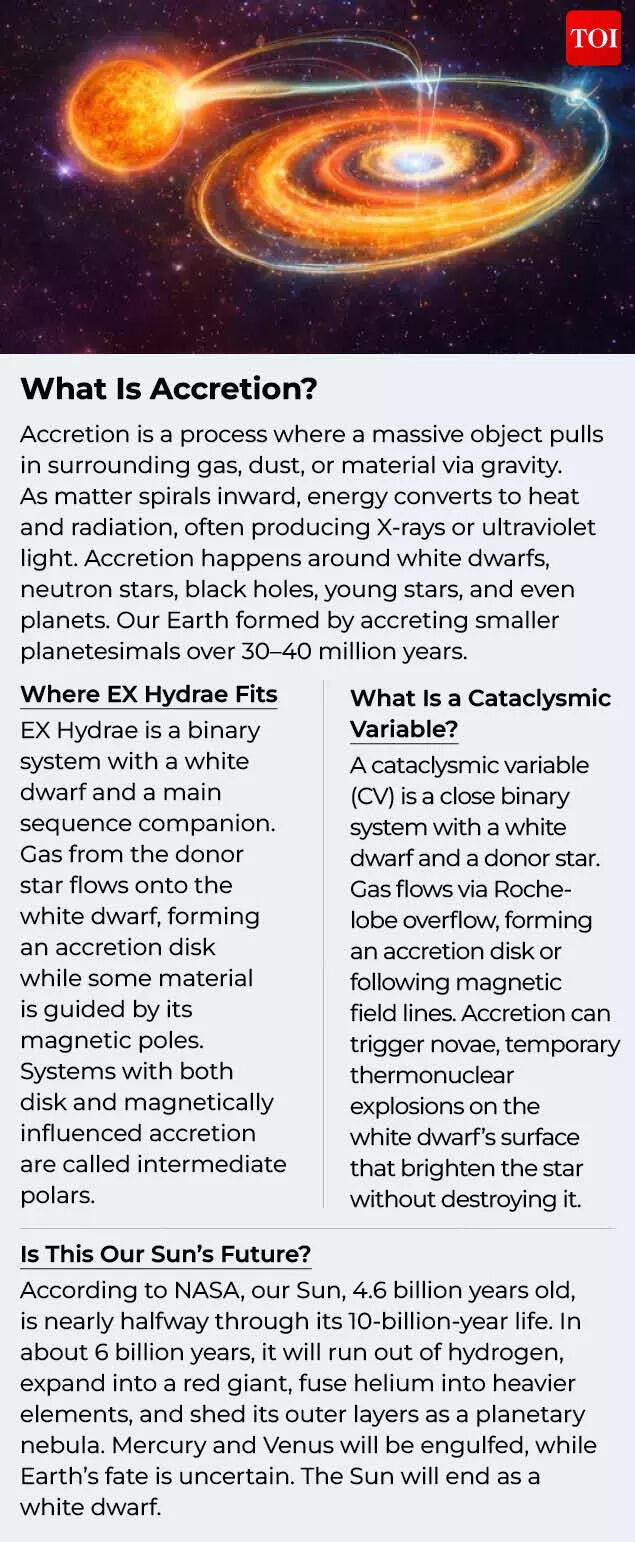
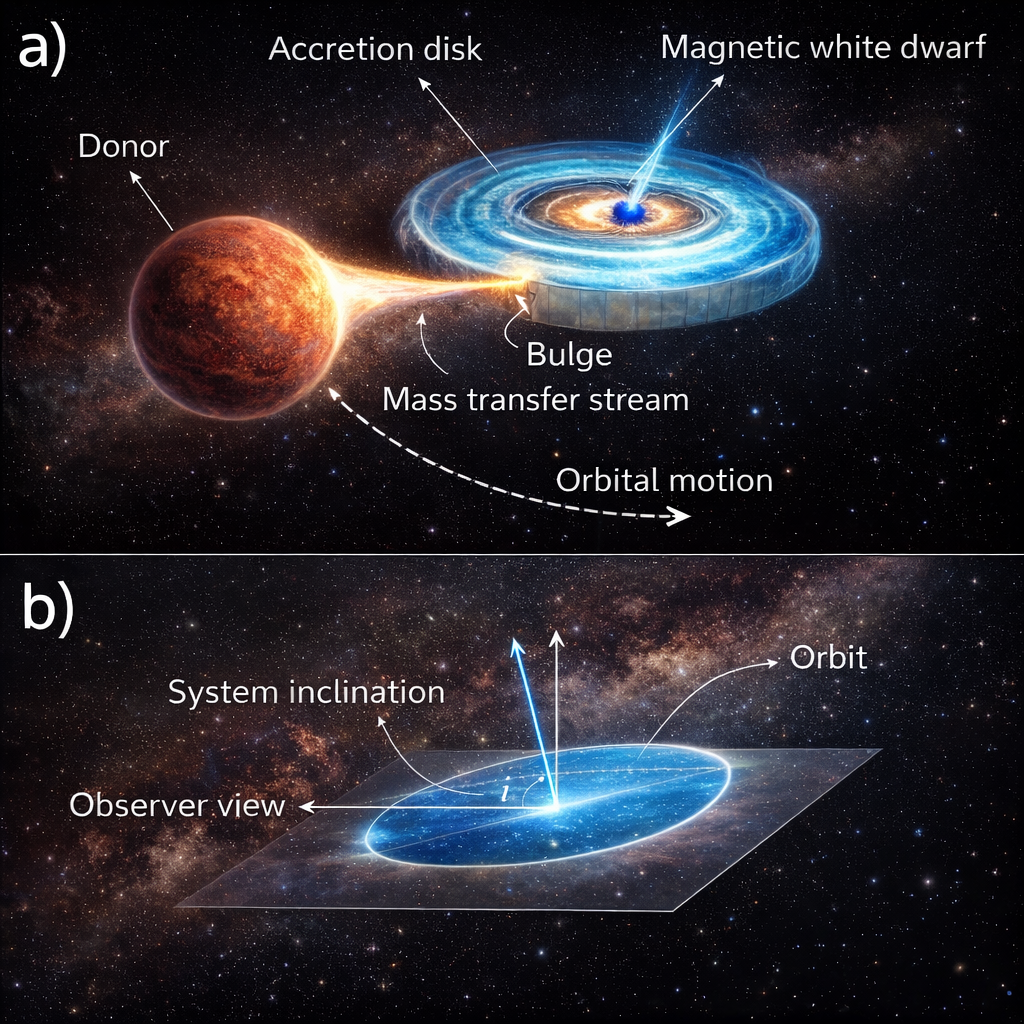
In astrophysics, accretion refers to the process by which a massive object gravitationally captures and accumulates material from its surroundings. This process occurs in a variety of cosmic environments, from young stars gathering gas in stellar nurseries to compact remnants such as white dwarfs, neutron stars, and black holes drawing in matter from nearby objects. In interacting binary star systems, accretion becomes especially dramatic and energetically important.When a white dwarf or other compact object orbits close to a companion star, the intense gravity of the denser object can pull gas from the outer layers of its partner. In many systems, this material does not fall directly onto the compact object but instead spirals inward, forming a swirling structure known as an accretion disk. Friction and gravitational forces within the disk heat the gas to extremely high temperatures, causing it to emit radiation across the electromagnetic spectrum, including X‑rays in high-energy systems.
–
In white dwarf systems, the gas being accreted is primarily hydrogen. As this hydrogen builds up on the dense surface of the white dwarf, pressure and temperature steadily increase. Because the white dwarf’s matter is degenerate, meaning it cannot expand to cool, the pressure continues rising until nuclear fusion occurs explosively in the accumulated layer. This thermonuclear runaway causes a nova outburst, during which a large amount of the accumulated gas is ejected, and the system brightens dramatically.
Source: Ebrahim Ghaderpour
Accretion is not limited to white dwarfs. Neutron stars and black holes in binary systems can also accrete matter from companions, producing intense X‑ray and gamma-ray emission. In some cases, if a white dwarf accretes enough mass over time, it may approach the Chandrasekhar limit of 1.4 solar masses, potentially triggering a Type Ia supernova explosion, which destroys the star entirely.
When codependency goes too far
Many of the universe’s most volatile relationships occur in binary systems that include a white dwarf. Roughly the size of Earth but containing the mass of the Sun, a white dwarf packs extraordinary gravity into a very small space.When such a star orbits close to a companion, often a normal main-sequence star or a swollen red giant, its gravity begins pulling material from the companion’s outer layers. This stolen gas, mostly hydrogen, does not fall straight onto the white dwarf. Instead, it spirals inward, forming a hot, glowing accretion disk. Over time, hydrogen builds up on the white dwarf’s surface. Pressure and heat increase until the gas ignites in a runaway nuclear reaction, resulting in a nova, a sudden and dramatic brightening.While the companion star clearly loses material, the white dwarf is not entirely safe either. If it pulls in too much mass too quickly, the consequences can escalate. Repeated accretion can push a white dwarf toward the Chandrasekhar limit, triggering a Type Ia supernova, which completely destroys the star. Even without reaching that extreme, the intense heating, magnetic stress, and violent infall of matter create unstable conditions. What begins as survival through dependence can ultimately become destructive for both partners, a cosmic reminder that imbalance rarely ends well.
What is a Cataclysmic Variable?
According to Nasa, a cataclysmic variable (CV) is a close binary star system where a white dwarf and a donor star orbit each other closely enough that the white dwarf pulls material from its companion. This material often forms an accretion disk around the white dwarf or is guided along its magnetic poles. As the gas accumulates on the white dwarf’s surface, it can heat up and trigger thermonuclear explosions, known as novae, which temporarily increase the star’s brightness without destroying it. CVs are important laboratories for understanding accretion, stellar evolution, and the physics of extreme gravity.
EX Hydrae: A toxic cosmic relationship seen in X-rays
EX Hydrae is a binary system located about 200 light-years from Earth in the constellation Hydra. Belonging to the class of cataclysmic variables, EX Hydrae consists of a white dwarf accreting material from a main-sequence companion.What makes EX Hydrae particularly intriguing is its classification as an intermediate polar. Here, the white dwarf’s magnetic field is strong enough to disrupt the accretion disk, but not strong enough to completely control it. Gas from the companion both swirls in a disk and funnels along magnetic field lines toward the white dwarf’s poles.As the material crashes down, it heats to tens of millions of degrees and forms towering columns of superheated plasma that emit high-energy X-rays. For the first time, scientists measured these structures directly using Nasa’s Imaging X-ray Polarimetry Explorer (IXPE). They found that one accretion column rises nearly 2,000 miles above the white dwarf’s surface, revealing unprecedented details about how matter behaves under extreme gravity and magnetic fields.
Another Nasa-observed case: HM Sagittae
Another striking example is HM Sagittae, imaged by Nasa’s Hubble Space Telescope. This binary system consists of a white dwarf siphoning material from a red giant companion. The white dwarf forms a hot accretion disk and launches energetic outflows, producing unpredictable eruptions, jets, and shocks.Hubble observations show expanding clouds of gas shaped by these interactions, offering a rare glimpse into how prolonged stellar feeding can reshape entire regions of surrounding space. HM Sagittae underscores that long-term imbalance in stellar systems does not remain contained, it alters both stars and their environment.
Types of stars
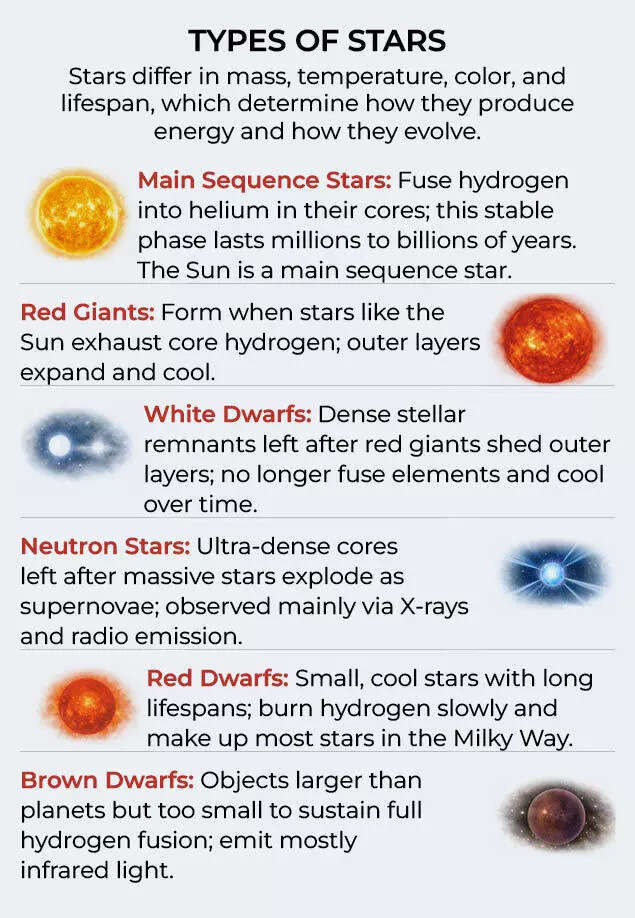
Stars vary in size, brightness, and lifespan. Main sequence stars, like our Sun, fuse hydrogen into helium for billions of years. Red giants expand when core hydrogen runs out. White dwarfs are dense remnants of Sun-like stars, while neutron stars are even more extreme, formed from massive stars’ supernovae. Red dwarfs are small, long-lived stars, and brown dwarfs are “failed stars” that never ignite full fusion. These different stars set the stage for cosmic interactions and dramatic stellar events.
Is this the fate of our Sun?
Our Sun, about 4.6 billion years old, is nearly halfway through its roughly 10‑billion‑year lifespan. According to Nasa, it is currently a main sequence star, steadily fusing hydrogen into helium in its core. In roughly 5–6 billion years, the Sun will exhaust the hydrogen at its core and expand into a red giant. As it swells, it will begin fusing helium into heavier elements such as carbon, nitrogen, and oxygen, while hydrogen continues burning in shells around the core.During this red giant phase, the Sun’s outer layers will expand outward, engulfing Mercury and Venus. Earth’s fate is uncertain: some models suggest it may just escape direct engulfment, but its surface would be scorched and stripped of atmosphere long before that point. Mars might survive direct engulfment, although its environment would still be drastically altered. After shedding its outer layers as a planetary nebula, the Sun will leave behind a white dwarf, a dense, slowly cooling stellar remnant roughly the size of Earth but with a mass similar to its current self.Our Sun, single for now, is unlikely to face the violent, codependent fate seen in some binary systems. It has no close companion to siphon its gas or trigger explosive outbursts, so it will quietly age into a white dwarf. In contrast, systems like EX Hydrae or HM Sagittae show how risky cosmic relationships can be. The white dwarf gains mass and energy from its companion, sometimes sparking dramatic novae or even a Type Ia supernova. The donor star steadily loses material and stability, while the accreting star risks overloading itself. These stellar partnerships reveal a cosmic dance where imbalance and dependence can be destructive for both sides, a fascinating reminder that in the Universe, codependent relationships have their own consequences. At the same time, studying systems like EX Hydrae allows scientists to explore what might happen under different circumstances and gain deeper insights into the eventual life cycle of stars like our Sun.