
Trump’s zero tariff on Bangladesh textiles: No reason for India to worry? Why exports are unlikely to rise much
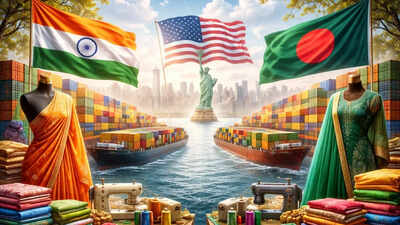
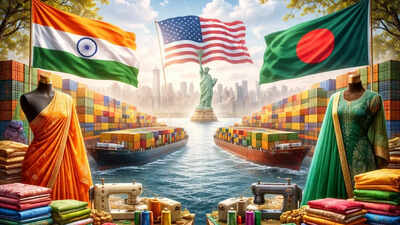
The US-Bangladesh trade deal has the Indian textile sector exporters worried? The Donald Trump administration has reduced the tariffs on Bangladesh to 19%, but a clause of zero tariffs on textile exports may hit the Indian textile industry.But how hard will India be impacted? According to a recent report by Global Trade Research Initiative (GTRI), the concession of zero tariffs to Bangladesh will not lead to a big surge in the country’s exports. The joint statement says the US will offer zero reciprocal tariff on garments which are made using US-origin cotton and man-made fibres.
How much will zero tariffs on Bangladesh textiles hurt India?
In practical terms, a Bangladeshi garment that normally faces a 12% US MFN tariff would attract a total duty of 31% (12% MFN + 19% reciprocal). For India, the comparable total would be about 30% (12% MFN + 18% reciprocal). But Bangladeshi garments made with US fibres would avoid the reciprocal duty, paying just the 12% MFN tariff, the GTRI report says.Also Read | Trump removes 25% penal tariff: What happens if India stops buying Russian crude oil?“While this appears to be a significant concession, Bangladesh’s export structure and its heavy dependence on non-US textile inputs mean the arrangement is likely to result in only a limited increase in garment exports to the U.S,” says Ajay Srivastava, founder of GTRI.In 2024, Bangladesh’s global garment exports were $50.9 billion, which is much higher than India’s $16.3 billion. More than 63% of Bangladesh’s exports were directed to the European Union, where shipments get duty-free access. Exports to the United States were $7.4 billion, with Bangladeshi garments continuing to face an average MFN tariff of about 12 percent after the withdrawal of US GSP benefits in 2019. Since the European Union remains Bangladesh’s primary market, its production and supply chains have largely evolved to cater to European demand and are unlikely to undergo rapid changes to comply with conditional US sourcing requirements, says GTRI.The structure of Bangladesh’s garment industry also reflects a strong dependence on imported raw materials. In 2024, the country imported fibres, yarns and fabrics worth $16.1 billion. China accounted for approximately $9 billion of these supplies, India for $3.1 billion, and the United States for only $274 million.At a more detailed level, the imbalance becomes clearer. Bangladesh imported cotton fibre worth $2.5 billion, with India supplying $655 million and Brazil $604 million, while imports from the United States were limited to $255 million.Also Read | 18% tariffs, boost to exports, agriculture protected: How India benefits from trade deal with US? Explained Cotton yarn imports totalled $1.8 billion, of which India alone accounted for $1.6 billion. In the case of fabrics, particularly woven synthetic filament fabrics that are critical for garment production, China remained the dominant supplier, providing $1.1 billion out of total imports valued at $1.4 billion, compared with just $88 million sourced from the United States.Out of total woven cotton fabric imports valued at $1.3 billion, China accounted for $601 million while India supplied $194 million. A similar trend is visible in synthetic filament yarn imports, where China contributed $329 million out of a total of $442 million, compared with $53 million from India.The significant share of yarn and fabric imports relative to fibre imports indicates that less than one-third of Bangladesh’s garments are produced starting from raw fibre. Most apparel manufacturing relies on imported yarns and fabrics rather than basic fibre inputs. The United States primarily supplies raw cotton to Bangladesh and that too in relatively small quantities, whereas India and China provide the yarns and fabrics that form the backbone of Bangladesh’s garment production. In order to benefit from zero-tariff access, Bangladesh would need to replace long-standing suppliers and make substantial investments in spinning and fabric-processing infrastructure, capacity that is currently limited, says GTRI.Since the European Union accounts for nearly two-thirds of Bangladesh’s garment exports and already provides unconditional duty-free access, the incentive to reorganise supply chains mainly to serve the US market remains limited.