
They built a fake Earth and sealed people inside it for 2 years for an experiment |
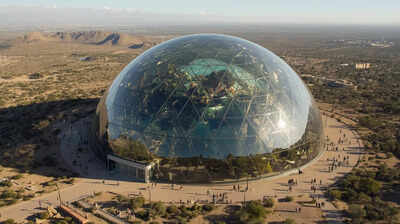
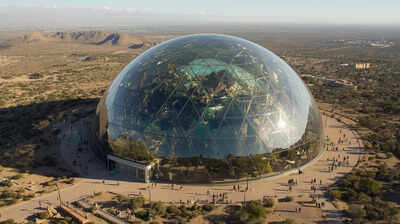
In the Arizona desert, a vast glass structure sits far from cities and farmland. It was built to test an idea that once seemed urgent and uncertain. Could humans survive inside a closed world with no outside air, food or assistance? The project is known as Biosphere 2, a sealed research facility designed to reflect Earth’s living systems. In the early 1990s, eight people were locked inside for two years as part of a high-profile experiment. The goal was not comfort, but understanding. The experiment aimed to understand how air, water, soil, and life interact in a closed system where nothing can be replaced. Today, the structure remains active, though its purpose has shifted. It is no longer about isolation alone but about observing Earth itself under controlled conditions.
A closed world built in the Arizona desert: A sealed experiment to copy Earth
Biosphere 2 covers 3.14 acres and sits under more than 7 million cubic feet of sealed glass. A welded stainless steel liner separates it from the ground below, preventing any exchange with the surrounding environment. Inside, the space is divided into several biomes, including a tropical rainforest, an ocean with coral, mangrove wetlands, savanna grassland and a fog desert.These environments are connected; change in one environment affects the other. As it’s human-made, it’s totally different from natural ecosystems; variables such as temperature, humidity and gas levels can be measured and adjusted. This level of control allows scientists to observe processes that are usually tangled together in the open world.
The experiment that sealed people inside
The most famous chapter of Biosphere 2 began in 1991, when eight participants entered the enclosure and remained there for two years. They grew their own food and recycled water, and they lived entirely within the system. No outside supplies were allowed.The experiment faced challenges. Oxygen levels dropped. Food production proved harder than expected. Personal tensions became public. Despite this, the mission demonstrated how complex and fragile closed ecosystems can be. It also revealed how little room there is for error when life support systems must function without backup.
Ownership shifted as science changed
The land itself has a longer history. In the 1800s, it formed part of the Samaniego CDO Ranch. Over time, it became a conference centre before being purchased in the 1980s by Space Biospheres Ventures, which built the current structure.In the mid-1990s, control passed to Decisions Investments Corporation, and Columbia University later managed the site. Research shifted toward plant science and carbon dioxide studies. Classrooms and student housing were added. In 2011, the University of Arizona assumed ownership and continues to run the facility today.
A research site focused on Earth systems
Under university stewardship, Biosphere 2 now supports long-term environmental research. One of its major installations is the Landscape Evolution Observatory, where scientists study how soil, water and rock interact over time. These experiments aim to better understand erosion, water cycles and the effects of climate change.Funding comes from a mix of private donations and public grants, including support from the National Science Foundation. The site also plays a role in education, hosting students, researchers and visitors from around the world.
A quiet place that still draws attention
More than three million people have visited Biosphere 2 since it opened. Many come expecting a relic of a failed dream. What they find instead is a working laboratory, still evolving.The glass walls remain sealed. Inside, ecosystems continue to shift in small, measured ways. The desert outside stays dry and unchanged. Biosphere 2 does not promise answers about space colonies anymore. It offers something slower. A place to watch Earth behave when there is nowhere else to turn.