Russia, minerals or whim? Why Trump is after Greenland – and what are his options
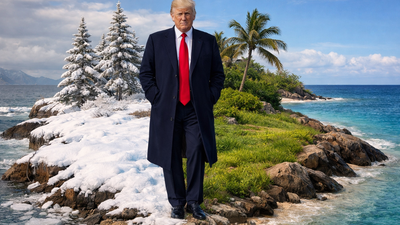
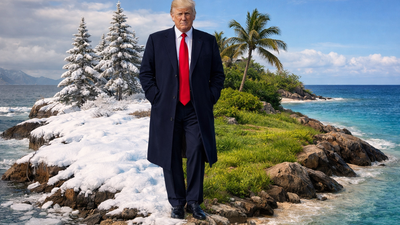
Just days after Venezuela’s president Nicolás Maduro was captured, US president Donald Trump revived his controversial territorial ambition: bringing Greenland under American control. Trump insists the United States “needs” Greenland for national security, pointing to rising Russian and Chinese activity in the Arctic and the strategic shifts triggered by melting ice. He has refused to rule out the use of military force, a stance that has infuriated Denmark, which governs the vast, mineral-rich island as a self-governing territory.
European leaders have responded with alarm. Denmark’s prime minister Mette Frederiksen has warned that any US attempt to seize Greenland would spell the end of Nato itself, while leaders from Britain, France, Germany and Italy have lined up behind Copenhagen, stressing that “Greenland belongs to its people”.
Yet beneath the rhetoric lies a more complex question: what does Trump actually want from Greenland? Is this about missile defence and Arctic security, access to critical minerals, or something more symbolic – a revival of 19th-century expansionism dressed up as modern geopolitics?
A strategic island the US already dominates
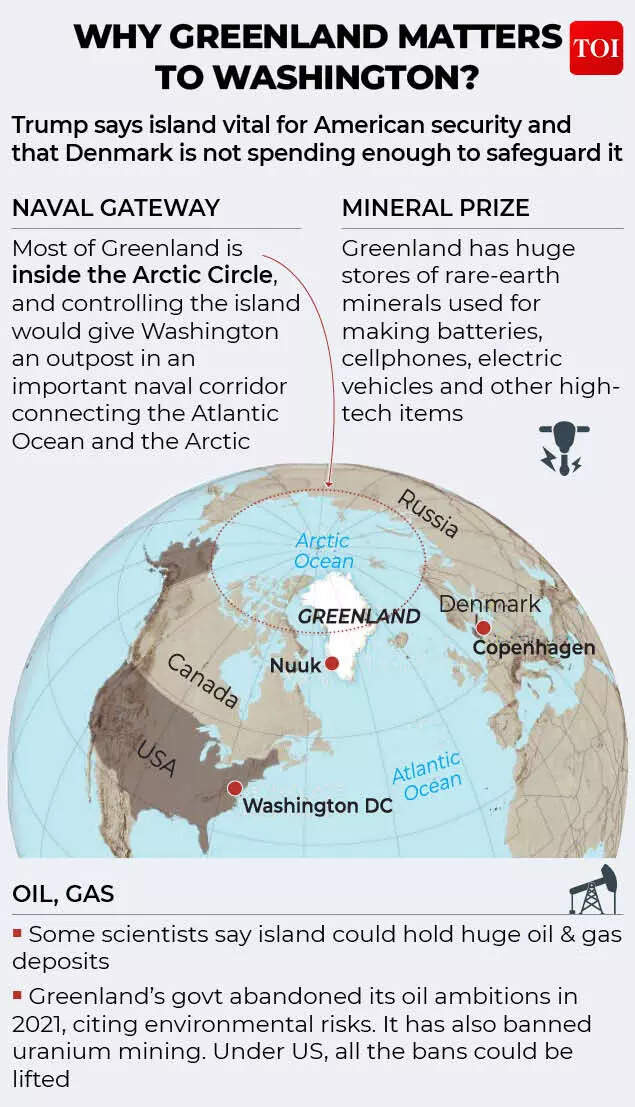
Greenland’s importance to US security is not in doubt. Sitting between North America and Europe, it straddles the GIUK gap – the maritime corridor linking the Arctic to the Atlantic. During the Cold War, Washington feared Soviet missiles would pass over the island on their way to the US, prompting a heavy American military presence.
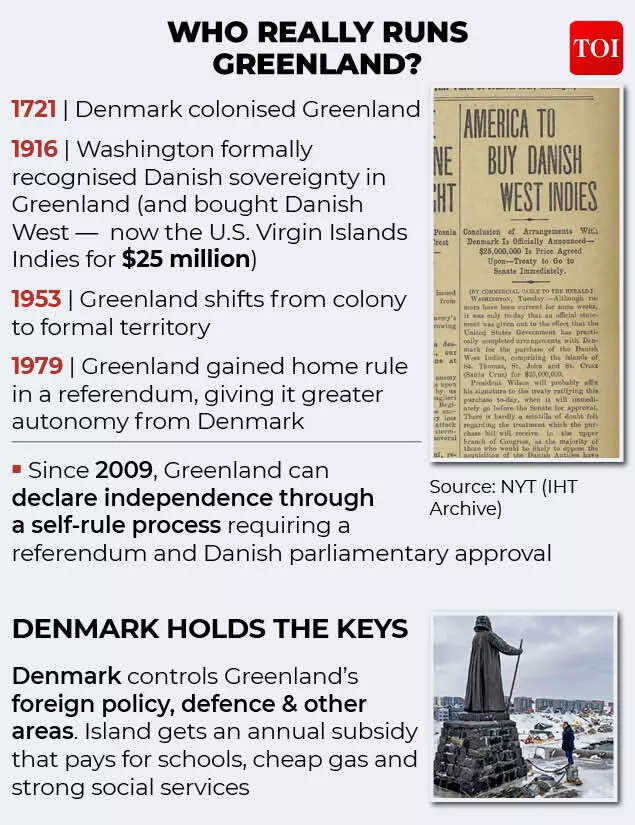
That presence never fully disappeared. Under a 1951 defence agreement with Denmark, the US operates the Pituffik Space Base in north-west Greenland, a critical hub for missile warning, missile defence and space surveillance. At its Cold War peak, the US stationed up to 6,000 troops across the island; today fewer than 200 remain.
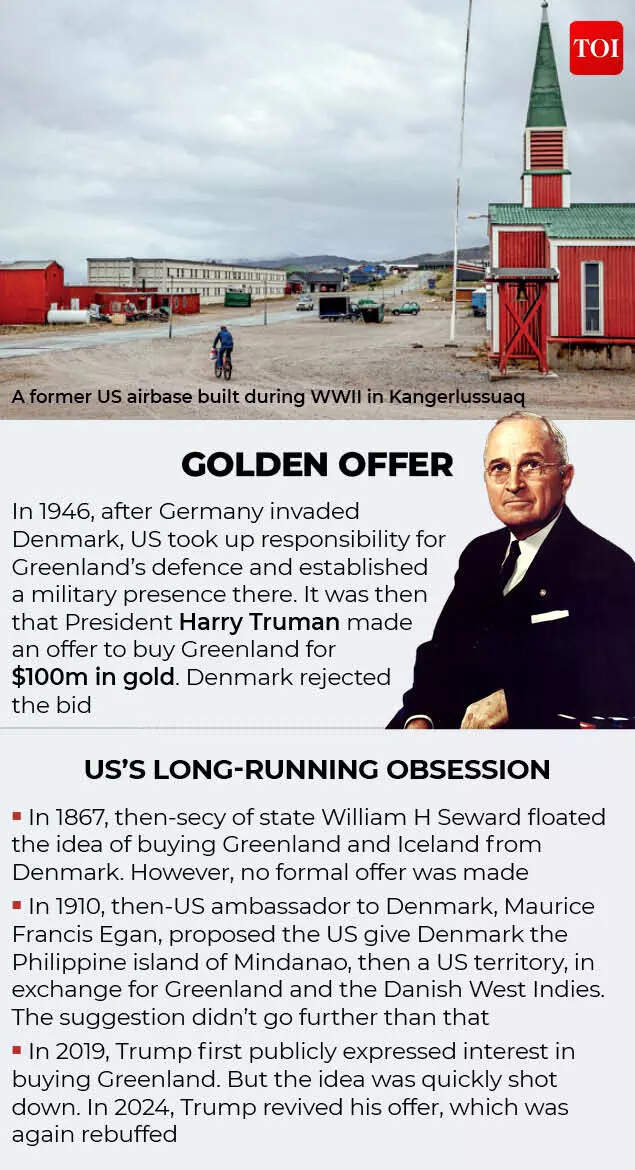
Crucially, the treaty allows Washington to expand its military footprint with little more than formal notification to Copenhagen. As Kristine Berzina of the German Marshall Fund has noted, the US could significantly increase its presence “without anything really needing to be done”.This is why Trump’s fixation has puzzled many allies. Denmark has repeatedly offered the US more bases, deeper defence cooperation and greater freedom of operation. If security were the sole concern, the legal framework already exists.
Greenland’s mineral wealth
Greenland’s frozen landscape hides significant mineral resources, but the scale is often overstated — and the obstacles to extracting them remain immense. According to the United States Geological Survey (USGS), Greenland is estimated to hold around 1.5 million metric tonnes of rare earth elements, placing it among the world’s notable but not dominant reserves. That figure is comparable to the United States and larger than Canada’s, yet far smaller than China’s estimated 44 million metric tonnes, which still accounts for nearly half of global reserves.Most of Greenland’s rare earth deposits are concentrated in the island’s south, particularly at sites such as Kvanefjeld, which contains minerals critical for electric vehicles, wind turbines and defence technologies. The appeal lies not just in volume but in the mix of light and heavy rare earths, which are harder to source elsewhere.
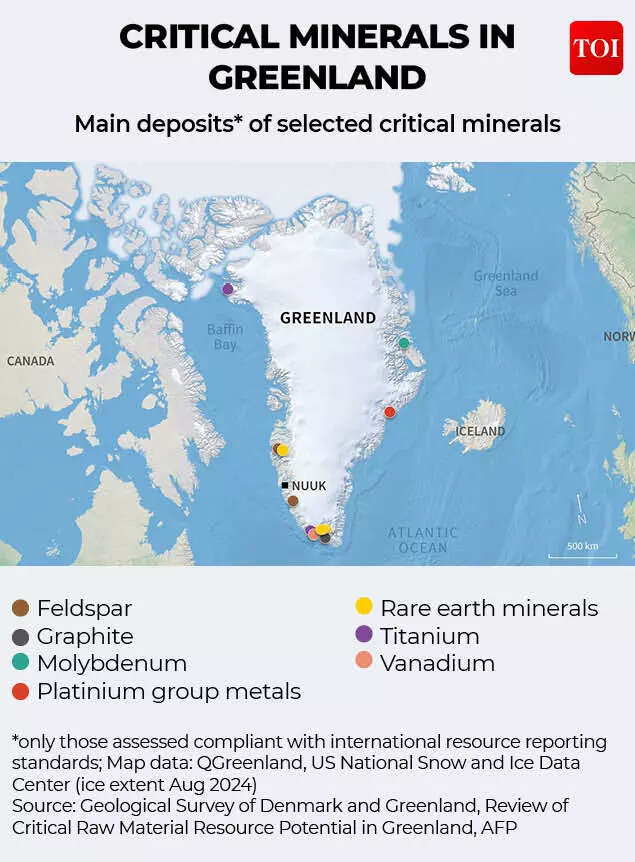
However, Greenland’s mineral wealth is largely untapped. Only one mine is currently operational, and the sector generates negligible revenue. Harsh weather limits mining to a few months a year, while the island lacks roads, ports and energy infrastructure needed for large-scale extraction. Environmental restrictions, including a 2021 law limiting uranium byproducts, have further slowed projects.
For MAGA, size – and symbolism – matters
Trump’s rhetoric suggests something else is at play. Since returning to the White House, he has spoken of a revived “Manifest Destiny” and floated what aides jokingly call a “Don-roe Doctrine” – an aggressive reimagining of America’s claim over the Western Hemisphere.Greenland fits neatly into that worldview. It lies geographically in North America, is roughly the size of Alaska, and has just 57,000 inhabitants. Incorporating it would catapult the US past China to become the world’s third-largest country by landmass, behind only Russia and Canada.For Trump’s Make America Great Again movement, that symbolism matters. “This notion of maps and legacy is important,” Berzina has said. “American greatness, in very literal terms, matters a lot to MAGA.”That may explain why Trump has escalated his language even as allies offer diplomatic off-ramps.
Buying Greenland
The White House says Trump is studying the option of purchasing Greenland, reviving a proposal first floated in the 19th century and last formally attempted by President Harry Truman in 1946.There is precedent. The US bought what are now the Virgin Islands from Denmark in 1917 for $25m in gold, after quietly threatening to seize them to prevent a German takeover during the First World War. Denmark eventually relented.This time, Copenhagen and Nuuk have been unequivocal: Greenland is not for sale. Opinion polls suggest just 6 per cent of Greenlanders support joining the US, while 85 per cent are opposed.Even if Trump attempted to sweeten the deal with large cash payments, legal hurdles would be immense. Any purchase would require congressional approval and would collide with international principles of self-determination. As Brian Finucane of the International Crisis Group put it, many of these options “exist in principle” but are “fairly far-fetched”.
Independence and a ‘free association’ deal
A more subtle strategy under discussion in Washington is Greenlandic independence, followed by a Compact of Free Association (COFA) with the US – similar to arrangements with Micronesia, the Marshall Islands and Palau.Under such deals, states remain independent but rely on Washington for defence, granting the US exclusive military access in return for financial support. Advocates argue this would prevent Russia or China from gaining influence in a newly independent Greenland.Alexander Gray, a former Trump national security official, told the Financial Times that an undefended Greenland would be “coerced or absorbed” by rivals, making a US security umbrella essential.Denmark currently provides around $700m a year in subsidies to Greenland’s economy. Any US replacement would likely be expensive, while offering Washington little more security than it already enjoys.
Military action?
The most extreme – and destabilising – option is outright annexation. Danish officials privately concede that a US military takeover would be swift: Greenland has no territorial army, and Denmark’s Arctic forces are limited.The political fallout, however, would be enormous. Frederiksen has warned that a US attack on Greenland would mean “everything stops”, including NATO itself. European analysts argue it would destroy trust in US leadership and erode the global rule-based order.Thomas Crosbie of the Royal Danish Defence College has said the US would gain nothing by flying its flag over Nuuk rather than Greenland’s. “They already enjoy all the advantages they want,” he said. The real impact would be symbolic – changing the map, not improving security.For now, diplomacy continues. US Secretary of State Marco Rubio is due to meet Danish and Greenlandic officials next week, with the White House insisting diplomacy remains Trump’s “first option”.