
Remember the 11pm panic of forgetting a map for school? Here’s what parenting looks like in 2026 | India News
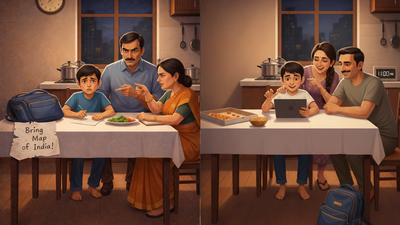
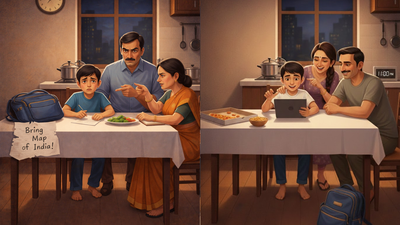
For many who grew up in India’s urban and metropolitan households, there was a time when forgetting to remind your father about bringing a chart paper or a political map of India meant a sleepless night of fear. The realisation would strike around 11 pm — too late, of course — followed by the certainty of what the morning would bring: anger, scolding, and a silent walk to school. You would run for your life if your mother caught you hiding test papers, instantly transform into an Oscar-worthy performer furiously finishing notebooks the moment you heard your father’s scooty pull in, or feel a familiar knot in your stomach before a parent-teacher meeting — one where the dreaded remark would glare back across the table: “Sir, Ma’am, your daughter/son is very talkative.”A casual greeting from a classmate in the market could be just as unsettling, inviting raised eyebrows and quiet questions later at home. For those disallowed from using mobile phones before their Class 12 boards, messages were typed secretly on keypad phones, the beep muffled so it wouldn’t be heard — sending elephant jokes or whispered secrets to friends like a thief.These memories are largely rooted in urban, middle-class childhoods — shaped by nuclear families, school-centric lives, and early exposure to rules, routines, and discipline within the home. Parenting experiences across India are far from uniform, but it is within these urban belts that the shift from authority to dialogue is most visible today.Today, phones are so firmly glued to hands that parents often become background noise, their presence acknowledged only when they call you for dinner or scold you for missing chores — an ironic reversal from the days when children moved quietly to avoid detection. And there were always two food choices on the dinner table: one, eat the green vegetables mom cooked; or two, don’t.Today, the same situations play out very differently. A child might suggest a 10-minute delivery app, and parents might laugh instead of scold. Friends are no longer viewed with suspicion but accepted as a natural part of growing up. From parents as unquestioned authority figures — stern, guarded, and rule-bound — to parents who attempt to balance discipline with dialogue, the parent–child dynamic has evolved significantly.Where once there was unspoken hesitation between parent and child, certain music, movies, or topics were strictly off the table. Today, children often assure their parents that such things are “not a big deal,” reflecting a more open, negotiable space where dialogue has replaced silent compliance.There exists one generation that largely obeyed and followed the route map carefully curated by their parents. Another listens, responds, and sometimes rebels — demanding to be understood, not merely permitted. Tech-savvy and exposed to the world far earlier than children once were, today’s young people often see beyond their years, assert their individual needs, and understand their own boundaries with remarkable clarity. It is within this generational shift that parenting styles diverge and relationships are reshaped.To be a parent, after all, is not a task for the faint-hearted.It involves raising, teaching, understanding, and eventually befriending a human being — one who can at times be stubborn, questioning, and who ultimately grows into a person of their own temperament.Parenting is a test most are never fully prepared for, a daily examination governed by an unending list of don’ts and dilemmas. This evolution is not a judgment on any generation of parents; most only want the best for their children, often even what they themselves could not achieve — not to burden them, but to build them for the world.Parenting, in essence, can be seen as a negotiation of fear, affection, aspiration, and trust. It is about guiding a human through the unknown while learning to let go, adapting as the child grows, and discovering that the rules of yesterday may no longer apply to the realities of today. The arc from strict discipline to dialogue, from unquestioned authority to mutual respect, reflects not just a change in homes, but a transformation in the very way we imagine childhood, the transition into adulthood, and the delicate dance in between.
Parents reflect: From authority to supportive guidance
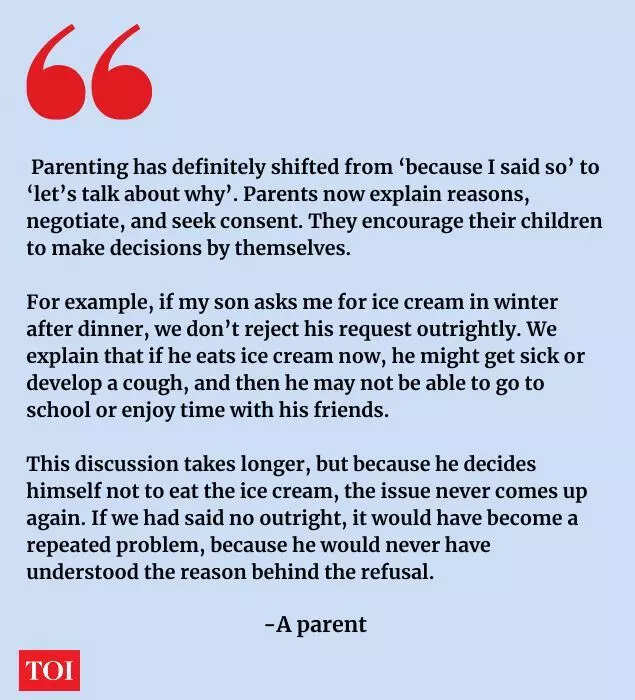
Parenting today has evolved significantly from the rigid, authority-driven approach of the past. Parents we spoke to shared nuanced views on balancing discipline, guidance, and modern realities, emphasizing the importance of empathy, communication, and trust.One mother explained how she navigates the realities of technology with her 15-year-old daughter: “While I remind her to study, I cannot ignore that phones have become a part of life. I try to balance this by not only allowing social media but also being tagged in reels my children share. What could be a distraction becomes a way to connect with them.”Another parent highlighted the risks of overly strict discipline: “If we are too firm, our children might trust outsiders before coming to us. We ought to be the first ones they share with.” Similarly, patience and empathy were emphasized by another parent: “We try to handle differences calmly. Anger often makes children fear rather than respect, but bad behaviour still needs to be called out.”Parents today increasingly favour guidance and understanding over rigid enforcement. One parent reflected on how the approach to parenting has shifted over generations:“Earlier, parents were strict, and children dealt with that strictness. Today, children prefer supportive guidance and warm communication. They enjoy interactive learning through activities. Children catch on quickly and need parental involvement. I focus on love, care, empathy, and independence when needed, balancing affection with healthy development.”Another parent raising three children, including a Class 10 student, shared how she balances guidance and independence:“We consciously try not to be as authoritative and strict as our parents were. Instead, we try to give our child a safe and comfortable space. Earlier, parenting focused on strictness and outcomes, while emotional support was often ignored. Today, communication matters more.”She added that while friendship in parenting is desirable, balance remains crucial:“Friendship is important, but it must be balanced with firmness. We listen and allow our children to share freely, but rules are also made clear. Boundaries help children feel supported while learning responsibility.”Reflecting on his own upbringing, one parent noted that fear-based discipline often leads to secrecy rather than responsibility. “My reaction to my son’s mistakes has always been a hug, followed by a calm discussion. If children see their parents as a safe space, they are more willing to confide.”
–
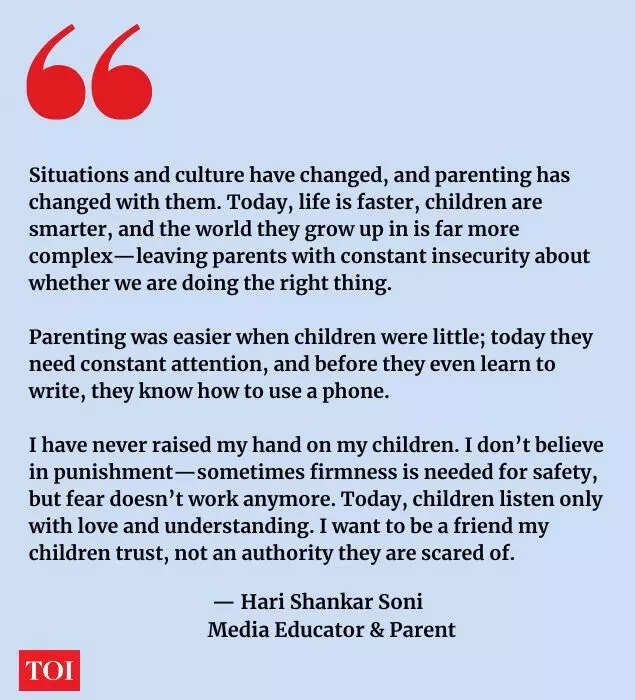
Hari Shankar Soni, a media educator and father of two daughters, emphasized how parenting must adapt to modern realities: “I had my share of strict discipline from my father once. But, I have never raised hand on my children; I cannot imagine doing that with my kids. I don’t believe punishment works for this generation. I want to be a friend, not an authority they fear.”
–
Children’s perspectives
To understand parenting from the children’s point of view, we spoke to students across age groups. Their voices reveal how guidance, boundaries, and emotional support play out daily.Rubal, a Class 10 student in Delhi, shared: “My parents usually listen to my opinions, even if they don’t fully agree. They support me when I make mistakes. I wish they trusted me more on issues like career and mobile use, and understood that mistakes are part of growing up.”A Class 11 student echoed similar feelings: “My parents are supportive and provide solutions, but we differ on issues like marriage. They value security, while I think differently. I wish they understood my personality better.”A Class 6 student said: “My opinions are considered, and my parents explain things calmly. But sometimes I feel distant when they are strict about friends or social media.”A Class 9 student added: “I enjoy fun banter with my parents, but comparisons with others sometimes bother me. I try to voice it out.”Together, these voices suggest that children today seek understanding without absence, freedom without neglect, and boundaries without fear.
Teachers’ insights: The classroom mirror
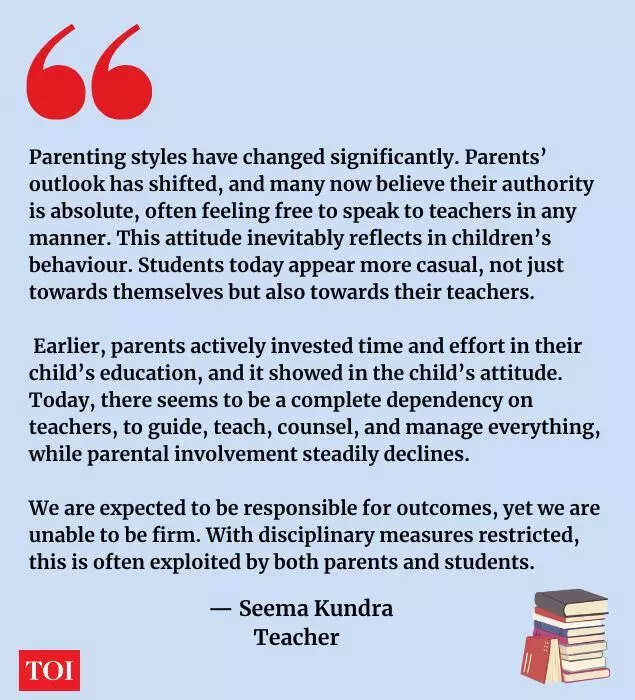
Seema Kundra, a teacher with over 25 years of experience, says classrooms today reflect changing parenting styles, especially after Covid. “Many parents speak to teachers without filters, believing their authority is absolute. This attitude shows in children, who are far more casual with teachers.”
–
She added that excessive screen time has widened the gap. “Parents sometimes criticise teachers in front of children, which undermines authority. Compared to five years ago, parental involvement has reduced.”
–
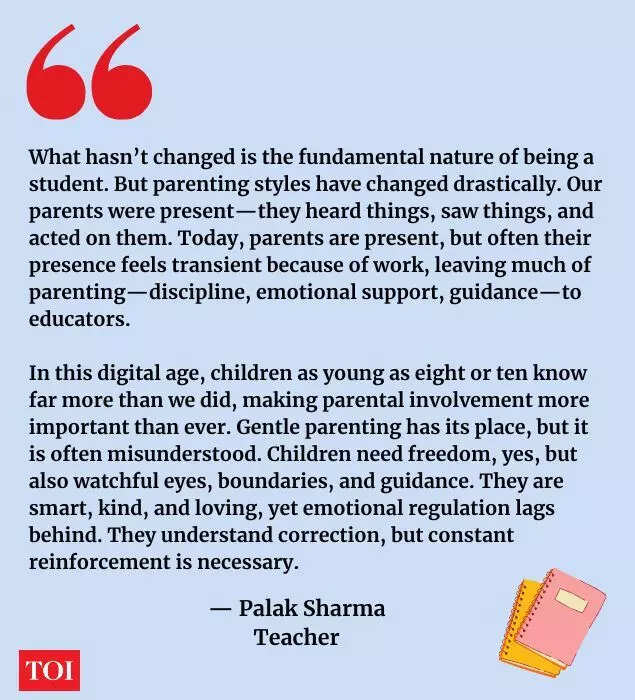
Palak Sharma, a young educator, said the contrast is “worlds apart.” “Parents are present, but often transient due to work. Discipline and emotional support are pushed onto teachers.”While supporting gentle parenting, she cautioned against misinterpretation. “Gentle parenting has become an excuse to avoid discipline. Children need freedom, but also guidance and boundaries.”Gauri Chandna Budhiraja noted that while parents are more engaged, “this sometimes crosses into over-protection and pressure.” Feedback that was once accepted, she said, is now often negotiated.
From the psychiatrist’s lens
Dr. Rajiv Mehta, Vice-Chairperson (Psychiatry) at Sir Ganga Ram Hospital, stressed that the emotional climate at home plays a critical role.“Over-interference, hostility, and constant criticism create a damaging cycle. Parents pass anxiety to children, who then struggle emotionally.”He added: “Today’s helicopter parenting limits children’s independence. Earlier generations allowed more freedom to explore.”
Parenting styles explained: Where families stand today
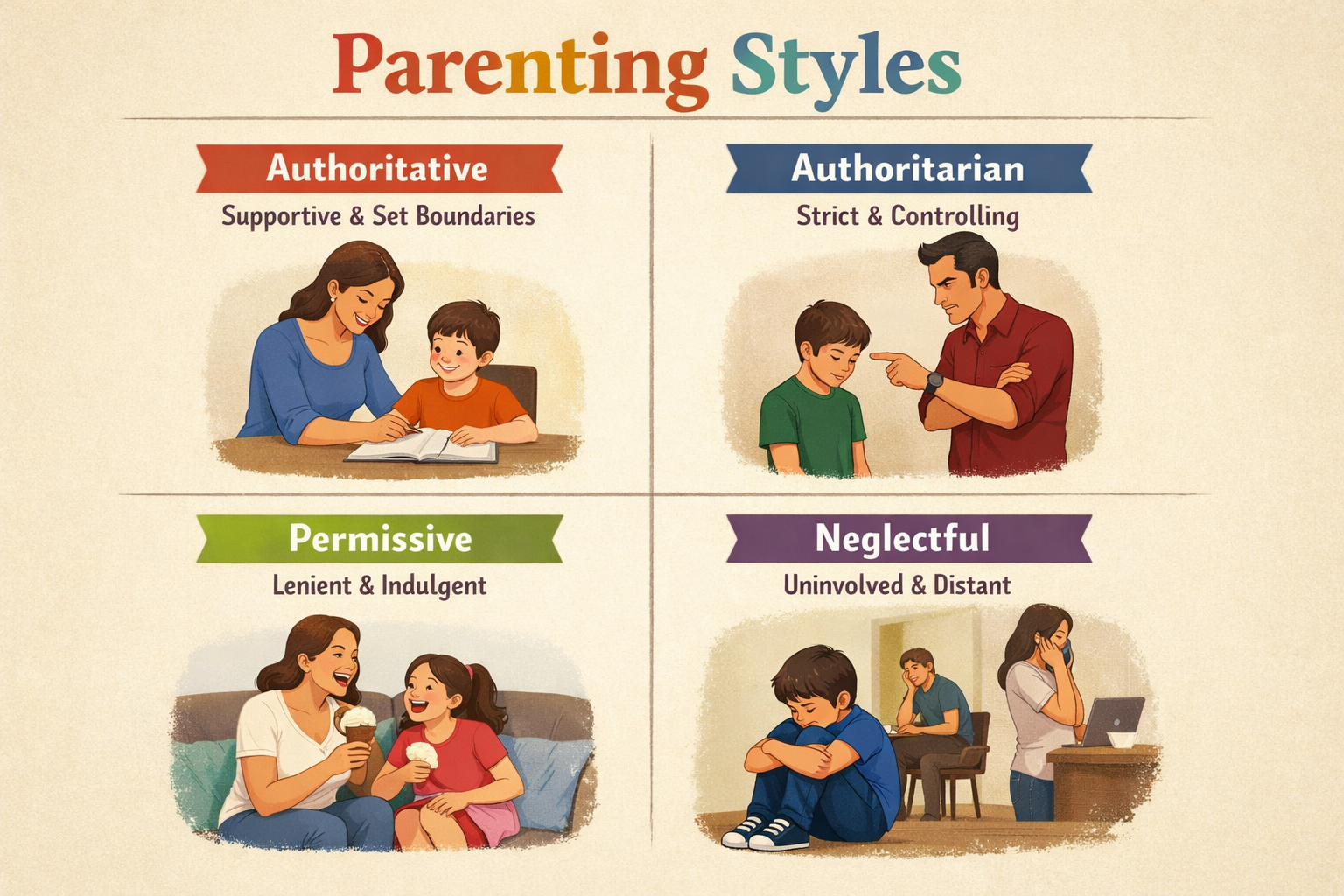
Psychologists commonly classify parenting into four styles, first outlined by Diana Baumrind and later expanded by Eleanor Maccoby and John Martin:• Authoritarian: High control, low warmth• Permissive: High warmth, low structure• Authoritative: Balanced boundaries and emotional support• Neglectful: Low responsiveness and guidance
.
What emerges today is a shift away from rigid authoritarianism. Most families attempt authoritative parenting, though many struggle to find balance amid technology, time scarcity, and rising anxiety.
Raising children in a changed world
Parenting is never one-size-fits-all. Styles evolve with social realities, work pressures, culture, and mental health. Authority has softened into dialogue, fear into negotiation, and silence into openness. Yet closeness without boundaries can be as unsettling as discipline without empathy.Children today are more aware and expressive, but also face heightened emotional pressures. Parents, meanwhile, are caught between doing better than the generation before them — and fearing they may be doing too much, or too little.