Putin-Modi meet: How India became Russia’s lifeline – but on its own terms | India News

Driving the news
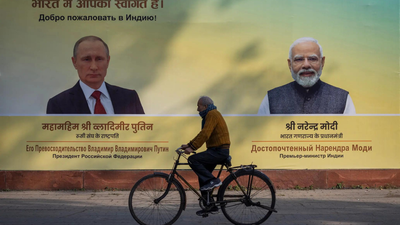
Russian President Vladimir Putin is landing in New Delhi today for a high-stakes two-day summit with Prime Minister Narendra Modi – his first state visit to India since the Ukraine war began in February 2022.
- With new US sanctions throttling Russia’s oil exports and global isolation deepening, Moscow is turning to India with warm words and strategic asks.
- Kremlin spokesperson Dmitry
Peskov called India a “historic partner” and thanked it for its “friendly stand” on Ukraine – a notable shift in tone as Moscow seeks to protect its last big energy customer outside China.
“We are proud to stand shoulder to shoulder with India,” Peskov said, framing the summit as a reflection of “deep trust and mutual respect.”Follow Vladimir Putin India Visit Live Updates
Why it matters
This is no ceremonial visit. It’s a transaction wrapped in tradition – a negotiation between a sanctions-hit petro-state desperate to stay relevant and a rising power determined to make every partner earn its place.
Putin needs India to remain open to Russian oil and arms – and not fully pivot to the West or China.- PM Modi needs assurances on energy stability, defense reliability, and Russia’s geopolitical neutrality – while carefully managing relations with the US.
The backdrop: India is walking a diplomatic tightrope – balancing its Cold War-era friendship with Moscow against growing economic and strategic stakes with Washington.
Between the lines: A fragile oil lifeline
Russia’s war chest still depends on oil – and India has become one of its few dependable buyers.
- India was buying just 2% of its crude from Russia in early 2022. Now it sources 35–40%, briefly overtaking China as Moscow’s top customer.
- But that flow is stalling. New US sanctions on Russian firms like
Rosneft and Lukoil are spooking Indian refiners. Imports have dropped and are expected to hit a 3-year low in December.
“We see this as a temporary disruption,” Peskov said, pledging “sophisticated” workarounds to maintain energy ties.The pressure: US lawmakers have accused India of being a “laundromat” for Russian crude – refining it and exporting finished products globally. Washington is leaning on India to scale back and buy more American energy.Also read | Putin’s India visit: From private dinner with PM Modi to Rajghat visit — what’s on the itinerary
The big picture: Moscow’s shrinking circle
Putin’s visit must be seen through the lens of global isolation and economic squeeze.Europe’s exit: The EU has slashed Russian crude and gas imports. G7 sanctions on tankers, insurers, and pipelines have bitten deep.Tech drought: Russia’s oil and defense sectors are struggling to source critical Western components.Asia pivot: With the West out, Moscow is leaning hard on China and India. China brings scale – but India brings strategic balance and global legitimacy.
Zoom in: A trade boom – with problems
India–Russia bilateral trade has ballooned to $68.7B in FY 2024–25, up from $13B in 2021. But almost all of it flows one way.
- Imports from Russia: $63.8bn – mainly crude oil, fertilizers, and coal.
- Exports to Russia: < $5bn – a mix of pharma, food, machinery, and electronics.
This imbalance isn’t just a diplomatic irritant – it’s also a financial headache.
- Sanctioned Russian banks are unable to repatriate dividends from Indian joint ventures like Sakhalin-1 and Vankorneft.
- India’s central bank is pushing for rupee–rouble settlements to bypass the dollar-dominated SWIFT system, but progress is slow.
“The imbalance is real,” Peskov admitted. “We are looking to buy more from India to fix it.”
Cheap oil, costly problems
India has benefited from discounted Russian crude – it helped ease inflation, boosted refining margins, and stabilized the rupee.But it has also brought three major side effects:
- A record trade deficit with Russia ($60bn).
- Frozen payments due to sanctioned financial channels.
- Diplomatic backlash from Washington and Brussels.
Still, India is unlikely to cut off Russian oil – it will simply recalibrate.
Defense ties: Still strong, but not what they used to be
Russia remains India’s biggest arms supplier – but that dominance is eroding.
- From 70% a decade ago, Russia’s share of India’s defense imports is now down to 36% (SIPRI).
- India is diversifying: Rafales from France, Apaches and drones from the US, and a push for indigenous platforms under “Make in India.”
- Still, Moscow is far from irrelevant:
- India signed a $248m deal this year to upgrade its Russian T-72 tank engines.
- Talks are on for Su-57 fifth-gen fighters and more S-400 air defense systems.
- Joint ventures like BrahMos missiles and AK-203 rifles remain cornerstones of the partnership.
Strategic signal: The new RELOS agreement – a logistics-sharing pact – gives India access to Russian military bases, and vice versa. Delhi already has similar deals with the US, Japan, France, and Australia.
The Trump factor: Tariffs, threats, and trade friction
President Donald Trump has emerged as a wild card.
- In August, Trump imposed 50% tariffs on Indian goods – citing oil imports from Russia as one justification.
- The administration has labelled India’s oil strategy “a security problem” and signaled more pressure could follow.
- Yet, negotiators are quietly working on a limited trade deal focused on digital taxes, market access, and regulatory clarity.
India’s challenge: Continue talking with Washington without appearing to bow – or ditch Moscow.“This is Modi’s strategic autonomy under stress,” said the Global Trade Research Initiative (GTRI), a Delhi think tank.
What Modi wants from Putin
Putin may be wooing, but Modi isn’t giving anything away for free.India’s demands:
- Trade rebalancing: Russia must walk the talk and buy more Indian goods – especially in pharma, food, and light manufacturing.
- Secure payment systems: Delhi wants foolproof local-currency arrangements and clarity on remittances blocked by sanctions.
- Energy and nuclear cooperation: Commitments on oil volumes and pricing, plus guarantees on Kudankulam reactors and future small modular units.
- Geopolitical neutrality:India wants assurance that deepening Russia–China ties won’t be weaponized against Indian interests in Asia.
“Russia’s relationship with China is not against India,” Peskov said, emphasizing Moscow’s willingness to strengthen ties “as far as India is ready.”
What’s next
The Modi–Putin summit could produce:
- New defense contracts and S-400 delivery timelines.
- Updates to rupee–rouble frameworks or a BRICS-based payments corridor.
- Expanded use of RELOS for logistics and energy transit.
- A joint statement reaffirming “strategic partnership” in a multipolar world.
Apart from the oil and the arms, it’s diplomatic hedging, showing Beijing and Washington that Delhi has a third option and gives it a bit more bargaining room
Prof Kanti Bajpai to CNN
But every announcement will be weighed in Washington – and possibly followed by more US scrutiny or tariffs.
The bottom line
Putin’s Delhi visit isn’t just about oil or arms. It’s about staying visible, keeping options open, and proving Russia is still in the geopolitical game.
India has always been seen as a purely positive example. It is a non-Western country that is growing rapidly, plays by the rules, and focuses primarily on its own development without having excessive ambitions abroad.
An article in Russia Today
For India, the summit is a stress test of its global strategy: Can it be everyone’s partner – and no one’s pawn?“You can’t corner India,” said ORF’s Nandan Unnikrishnan. “You have to compete for it.”(With inputs from agencies)