
Penguins in Greenland? The story behind the viral ‘Nihilist Penguin’ meme
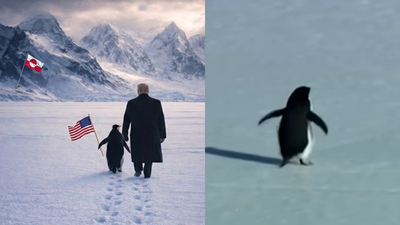
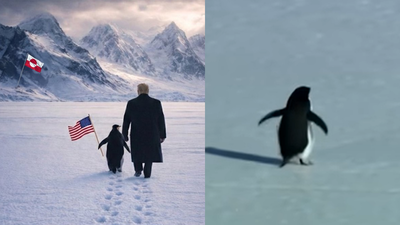
US President Donald Trump’s renewed focus on Greenland has taken an unusual turn, with the White House sharing an AI-generated image featuring the President walking alongside a penguin toward the Arctic island. The post, captioned “Embrace the penguin,” quickly drew attention online, not least because penguins do not live in Greenland or anywhere in the Northern Hemisphere.The image is now going viral on social media, triggering criticism and mockery from users who pointed out the geographical error, and others who were simply livid over Trump’s repeated assertion. The post came amid Trump’s continued rhetoric around Greenland, even as he has paused tariff-related tensions with Europe, and was seen by many as another symbolic assertion linked to his long-standing interest in the strategically located territory. However, the White House post was not the starting point of the internet’s sudden fascination with penguins. Even before Trump’s image went viral, penguins were already trending online, driven by a resurfaced documentary clip that has spawned millions of memes and sparked widespread debate over its meaning.
What’s the buzz about?
A short clip showing a lone penguin walking away from its colony toward distant Antarctic mountains has gone viral, earning the nickname “Nihilist Penguin.” Netizens have cast the animal as a symbol of existential crisis, rebellion and self-discovery. The footage originates from ‘Encounters at the End of the World’, a 2007 documentary by filmmaker Werner Herzog. In the scene, an Adélie penguin leaves its coastal colony and heads inland toward icy mountain ranges roughly 70 km from the sea — a direction that offers no food or breeding grounds for the species. Adélie penguins typically remain close to the coastline, where they breed and hunt. Long, purposeful inland treks are rare and not considered normal survival behaviour. The clip’s stark visuals and solitary subject have helped it gain renewed traction online nearly two decades after it was filmed.
Social media reacts
On social media platforms, users have overlaid the video with captions such as “The penguin knows” and “heading toward oblivion,” projecting human emotions and philosophical meaning onto the animal’s movement. Wildlife experts caution against such interpretations.Scientists say there are several possible explanations for the penguin’s behaviour. These include disorientation, particularly among younger or inexperienced birds; illness or injury affecting navigation; or rare instances of exploration or dispersal. “Well, I’ve never seen a penguin bashing its head against a rock,” says seabird ecologist Dr David Ainley in the documentary. However, he adds, “They do get disoriented.”He went on to say further that “even if they would have brought that lone penguin back into his colony, he probably would have again gone back towards the mountains.”Many stress that deviations from typical animal behaviour do not imply intent or awareness. In wildlife biology, such actions are usually attributed to individual variation, environmental stressors or health-related factors rather than conscious decision-making.
A psychological explanation
The big question is – Why did that penguin do so? Though there could be several permutations and combinations that could be brought together to present an explanation, one of them could be: In 1920 Sigmund Freud wrote a book – ‘Beyond the pleasure principle’ – in which he went on to divide human behaviour into two parts.One ‘Eros’ – the life instinct. This is the force that keeps us alive, pushing for survival and reproduction.Second ‘Thanatoos’ – the death drive. And this is the more dangerous of two.Freud argues life is full of chaos and tensions and Thanatoos being the force of repulsion and destruction pushes to put that chaos to end and return to silence. He makes the point that when one everyday wakes up and goes about daily life they push away Thanatoos.Probably that penguin didn’t have consciousness and couldn’t push away the Thanatoos.While the internet has turned the clip into a cultural symbol, scientists view it as an isolated and scientifically interesting observation — a reminder of the limits of human interpretation when applied to animal behaviour.