
Marine life recorded 3,800 metres deep on Titanic in the North Atlantic | World News
More than a century after it sank, the RMS Titanic continues to change in ways that are not only structural but also biological. A new survey of the wreck and a nearby deep-sea ridge has documented the animals now living across its steel surfaces at a depth of about 3,800 metres in the North Atlantic. The work draws on video collected during a 2022 expedition and compares life on the wreck with that found on a natural rocky ridge around 40 kilometres away. Researchers analysed more than a thousand still images taken from submersible footage. The results show that the Titanic has become an artificial reef, supporting corals, sponges and mobile invertebrates in an environment once dominated by soft mud.
Titanic wreck supports corals, sponges and deep-sea invertebrates
Footage from the wreck site shows brittle stars, squat lobsters, sea anemones and several species of sponge attached to railings and broken metal. Cold-water corals, including species in the genera Chrysogorgia and Lepidisis, have colonised elevated structures such as the bow and deck fittings.These organisms use the steel hull as a hard surface in an otherwise sediment-covered landscape. Before the ship arrived on the seabed in 1912, the area was largely muddy. The sudden introduction of complex metal surfaces created space for suspension feeders to settle and grow.Researchers recorded lower overall diversity at the wreck compared with the nearby ridge. Even so, the Titanic supports a distinct community shaped by its structure and slow decay.
Nearby seamount ridge hosts higher biodiversity than the wreck
The comparison site, part of a feature known as Seamount U, lies at roughly 2,900 metres depth. It is formed of volcanic rock and pillow lavas. In images from this ridge, scientists observed a greater number of species and higher diversity values than at the wreck.Dense clusters of corals, sponges, crinoids and fish were visible along rocky outcrops. The natural ridge appears to offer more stable habitat and possibly stronger currents that bring food particles.Statistical analyses showed that the community on the ridge differs markedly from that on the Titanic. Substrate type, local hydrodynamics and food supply are all likely factors.
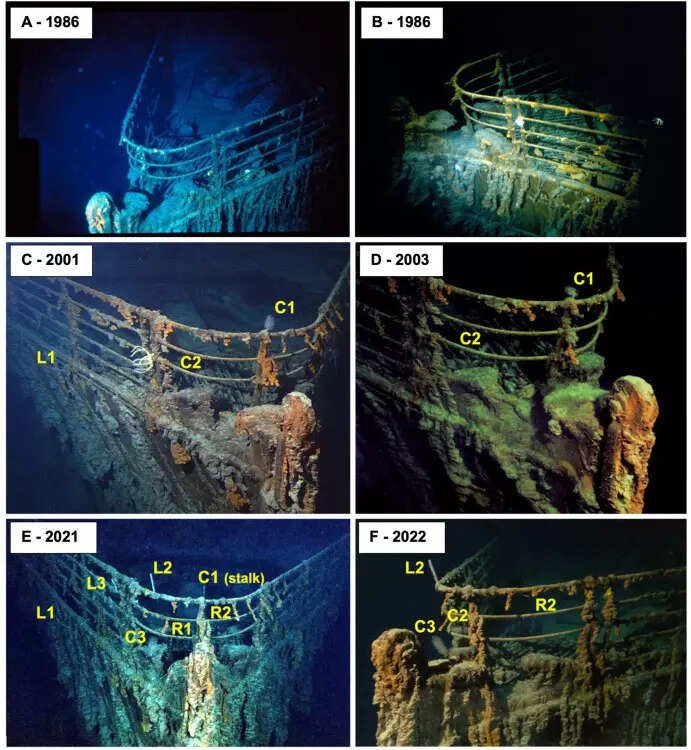
Long-term footage shows coral growth and rusticle change (Image Source – Science Direct)
Long-term footage shows coral growth and rusticle change
The team also compared recent images with archive footage dating back to 1986. Over time, certain coral colonies have increased in size. Estimated growth rates reached up to 10 millimetres per year for some colonies. Rust formations known as ‘rusticles’ have also extended, in some cases by around 14 millimetres per year.These changes point to an ongoing ecological succession. As the ship’s structure weakens, habitats may shift again. The wreck is both deteriorating and supporting life at the same time.
Deep sea shipwreck acts as artificial reef and ecological stepping stone
Shipwrecks at great depth are rarely studied in this detail. The findings suggest that artificial structures like the Titanic can act as stepping stones for species dispersal across the deep ocean floor. Larvae may settle on wrecks before spreading to other hard substrates.At the same time, climate change is expected to alter deep sea temperature, chemistry and oxygen levels in the North Atlantic. Such shifts could influence both coral growth and steel corrosion rates.For now, the Titanic remains a rare deep sea site visited often enough to allow comparison across decades. Its steel frames hold both history and a living community, slowly adjusting in the dark.