‘Likely caused by strangulation’: Doctor who observed Jeffrey Epstein autopsy makes shock claim about his death
Nearly seven years after the death of disgraced financier and pedophile Jeffrey Epstein, newly released Justice Department files have revived questions about what happened inside a New York jail cell in the early hours of August 10, 2019.Epstein, 66, had been arrested on July 6, 2019, at Teterboro Airport in New Jersey and was being held at Metropolitan Correctional Center in Manhattan while awaiting trial on sex trafficking charges. He pleaded not guilty and was placed in the jail’s Special Housing Unit over safety and suicide concerns.On July 23, he was found semi-conscious in his cell with an orange fabric noose around his neck. Epstein accused his cellmate, Nicholas Tartaglione, of trying to kill him. Tartaglione denied the allegation and later claimed in a pardon petition that he had been “deliberately” placed in the cell in the hope he would kill Epstein. The White House denied that claim.The following day, Epstein met a prison psychologist and denied he was suicidal. He insisted he had “no interest in killing myself” and that it “would be crazy” to commit suicide. “I have a life and I want to go back to living my life,” he said.After a period on suicide watch, he was returned to the Special Housing Unit on July 30 with a new cellmate and placed in a cell close to correctional officers. Because he was on “PSYCH Alert”, he was supposed to receive 30-minute checks and unannounced rounds.
Talks of co-operation and a new will
On July 29, federal authorities met Epstein’s lawyers. According to an FBI report, they “discussed the possibility of a resolution of the case, and the possibility of the defendant’s co-operation”. A separate document noted: “Defence counsel did not… indicate what the nature of Epstein’s co-operation might be, if any.”On August 8, Epstein signed a new will placing $577 million into a trust fund. His girlfriend, Karyna Shuliak, was to receive the bulk of his estate, including $50 million in cash and several properties. Ghislaine Maxwell and his brother Mark were each left $10 million.
Lapses inside the jail
On August 9, Epstein’s cellmate was moved out and not replaced, despite instructions that he should not be left alone. That morning, he met his lawyers in a conference room as new court documents alleging further abuse were released.That same day, an official statement about his death was drafted with the wrong date — August 9 instead of August 10. The Department of Justice later blamed an “unfortunate typo” and said: “Any suggestion that the department drafted a statement in advance of Jeffrey Epstein’s death is false.”By 4pm, guards Tova Noel and Ghitto Bonhomme began their shift but failed to complete a scheduled inmate count. Although they later recorded that checks had been carried out, Epstein did not return to his cell until 6.45pm after meeting his lawyers.At 10pm, inmates were locked in for the night. The guards did not carry out the required count, though they recorded that they had.At 10.30pm, surveillance footage showed Noel briefly walking to and from the entrance to L Tier, where Epstein was housed.
The ‘flash of orange’
At 10.39pm, cameras captured what an FBI memorandum described as “a flash of orange” moving up the stairs toward L Tier. The memo noted that it “looks to be going up the L Tier stairs – could possibly be an inmate escorted up to that Tier”.Inmates were issued orange clothing and bedding, and prisoners should have been locked in their cells at that hour. The Department of Justice’s Office of Inspector General later concluded the figure was an unidentified prison officer carrying orange “linen or bedding”.The FBI memo also recorded a “person” walking into view at 10.41pm “from the direction of either L Tier or exit to laundry room”.
Discovery of the body
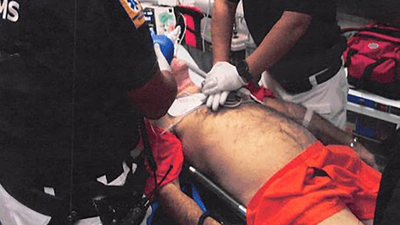
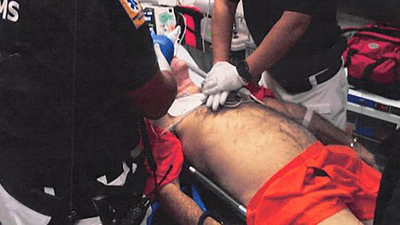
Between midnight and 6.30am on August 10, guards failed to complete required inmate counts and 30-minute wellness checks. Prosecutors later said they were asleep for three hours. The guards were charged with falsifying records but the charges were later dropped.At 6.33am, guard Michael Thomas found Epstein unresponsive in his cell. He later said he “ripped” him down from a near-seated position, hanging from a sheet. According to a corrections memo, Epstein was “cold” with “no palpable pulse.” Thomas told a supervisor: “Epstein hung himself.”Photographs taken soon after show the cell in disarray. By the time FBI agents arrived at 1.35pm, Epstein’s body had already been removed. Former detective Herman Weisberg, after reviewing the images, said: “It appeared that the scene was, for lack of a better term, staged a bit.”
Autopsy and official ruling
Dr Michael Baden, who observed the autopsy at the request of Epstein’s brother, said the neck injuries were more consistent with “strangulation pressure” than suicide. He said: “The markings [on Epstein’s neck] would have required a different type of material.”On August 17, New York’s chief medical examiner ruled the death a suicide after reviewing the evidence, including the blurred surveillance footage.Then-Attorney General William Barr acknowledged “serious irregularities” at the jail and later described events as “a perfect storm of screw-ups”.The newly released files have once again focused attention on the final hours of Jeffrey Epstein’s life, keeping alive questions about how and why he died inside a federal detention centre.