
‘How long are we supposed to live like this?’: Ammonia spikes, Delhi in throes of water crisis again | Delhi News
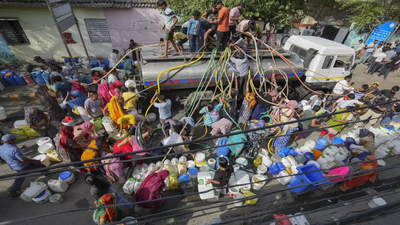
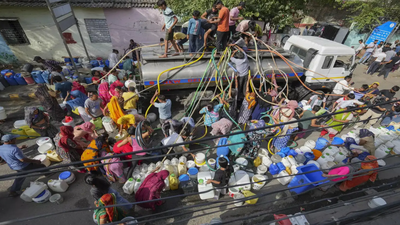
NEW DELHI: A prolonged disruption in water supply is unfolding across the national capital, leaving thousands of households struggling without regular access and fuelling concerns that the situation could persist well into next month. With treatment plants operating below capacity and pollution levels in the Yamuna remaining high, residents say the city is slipping into yet another extended phase of uncertainty. North, northwest, west, southwest and central Delhi are impacted.
In several neighbourhoods in north and west Delhi, taps remained dry for two consecutive days, forcing families to rely on stored water. Though limited supply resumed in a few pockets on Friday morning, residents said it was far from adequate. “Whatever water came today barely helps. We survive on cans now. It has become routine,” Rajesh Sharma, a resident of Subhash Nagar, told The Times of India.The concern goes beyond the immediate shortage. “If this is the situation now, what will happen in the coming weeks?” said Ashok Bhasin, president of the North Delhi Residents’ Welfare Association. “Every time there is a crisis, residents somehow adjust. But there is no clarity on when a permanent solution will come.”Residents of Kirti Nagar said the situation has worsened in recent days. “First, the water quality was poor, then the pressure dropped, and now there is no water at all,” a resident said, adding that they had been told the disruption could continue into next month. “The question is, how long are we supposed to live like this? We order water almost every day. Why is there no permanent solution?”Similar concerns were echoed across other parts of the city. “We plan our day around water availability — when to cook, wash or even bathe,” said a resident from west Delhi. “This is no longer an emergency. It has become a habit.”Residents also flagged serious gaps in tanker services, saying access was uneven and unreliable. “When individual residents call, there is no response. Even RWAs have to follow up multiple times to get one or two tankers,” Bhasin said. “One tanker cannot serve an entire society. This is not a solution.”“We are managing somehow today, but this cannot be the everyday reality,” said Sikander Singh, a resident of Dwarka.Officials attributed the current crisis to a sharp spike in ammonia levels in the Yamuna, a recurring winter issue aggravated by reduced river flow. While treatment plants are equipped to handle ammonia levels of up to 1 part per million (ppm), current concentrations have crossed 3 ppm, rendering the water unsuitable for treatment. The usual dilution method — diverting cleaner water from the Munak Canal — has failed as the canal is currently shut for maintenance.The problem has been further compounded by the absence of a dedicated ammonia removal facility at the Wazirabad plant. Without this infrastructure, officials said, the system remains vulnerable whenever pollution levels rise sharply.Adding to the strain is the ongoing closure of the Delhi Branch Canal and its parallel channel by Haryana’s irrigation department from Jan 20 to Feb 4. According to the Delhi Jal Board, the shutdown has significantly reduced raw water inflow, impacting production at major treatment plants in Haiderpur, Dwarka, Bawana and Nangloi.With multiple sources disrupted simultaneously, Delhi’s water network — designed to supply nearly 1,000 million gallons per day — has slipped into deficit mode. A senior government official said the situation is expected to improve by Saturday.He said a temporary maintenance-related diversion was done on a section of the canal network, for which Delhi was requested to receive its water share through alternative channels. During this diversion, water flow from Khubru towards the Yamuna increased, leading to a sudden spike in ammonia levels, which affected raw water availability for treatment in Delhi and resulted in temporary water scarcity.Efforts were made to stabilise the situation. However, as ammonia levels did not reduce, a decision was taken on Jan 22 to discontinue the maintenance work and restore the normal supply route, the official added.