Dubai, Abu Dhabi, Bahrain, Kuwait: Gulf countries targeted by Iran after US-Israel strikes
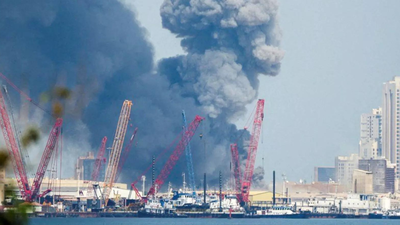
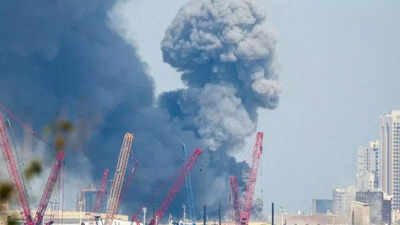
Iran has launched attacks on US assets across the Gulf in retaliation for a major joint strike by the United States and Israel, raising fears of a wider regional conflict.On Saturday, the Iranian government confirmed the attacks, according to the Fars news agency, citing targets in Bahrain, Kuwait, Qatar, and the United Arab Emirates, countries hosting airbases with US forces.
The United States maintains around 13 military bases in the Middle East, with 30,000 to 40,000 troops typically deployed across the region.Iran’s paramilitary Revolutionary Guard on Sunday threatened to launch its “most intense offensive operation” in response to the killing of Supreme Leader Ayatollah Ali Khamenei.“The most intense offensive operation in the history of the Islamic Republic’s armed forces will begin shortly, targeting Israel and US military bases,” the Guard said.In a letter to the United Nations Security Council and Secretary-General António Guterres, Iran’s foreign minister Abbas Araghchi stated that the country would “continue to exercise its right of self-defence decisively and without hesitation until the aggression ceases fully and unequivocally.”
United Arab Emirates
At least one person was killed in Abu Dhabi after several missiles launched from Iran were intercepted, according to the UAE’s state news agency, which provided no further details.In Dubai, a fire broke out near a hotel on the Palm Jumeirah Islands, sending plumes of smoke into the sky as multiple blasts were heard across the city. The Dubai Media Office later confirmed the “incident” in a building on Palm Jumeirah, which left four people injured. A luxury hotel was also hit during Iran’s strikes, carried out in retaliation for what Tehran described as a “massive” and ongoing attack by the United States and Israel.Earlier Sunday, the Dubai Media Office reported four injuries in an “incident” at Dubai International Airport, a major transport hub, noting only minor damage to the airport’s concourse.
Bahrain
Bahrain said a missile strike targeted the headquarters of the US Navy’s 5th Fleet in Manama, calling it a “treacherous attack” and “a blatant violation of the kingdom’s sovereignty and security.”Footage shared on social media appeared to show an Iranian Shahed drone hitting a nearby tower block, sparking a fire. The interior ministry reported that several residential buildings in Manama were also affected, with civil defence teams conducting firefighting and rescue operations, according to posts on X.Bahrain’s ambassador to the United States, Shaikh Abdullah bin Rashid Al Khalifa, described the assaults on “sites within the Kingdom” as a “blatant violation of sovereignty” in a statement on X.
Kuwait
Kuwait’s defence ministry reported that Ali al-Salem Air Base came under attack by multiple ballistic missiles, all of which were intercepted by the country’s air defence systems.Abdullah al-Rajhi, spokesperson for the General Authority of Civil Aviation, said a drone targeted Kuwait International Airport, causing “minor injuries to several employees” and inflicting material damage to the passenger terminal. Explosions were heard across the city as the attack unfolded.The official KUNA news agency cited a statement from the Ministry of Foreign Affairs affirming that Kuwait “maintains its right to defend itself.”
Qatar
Qatar’s defence ministry said it “thwarted” attacks on the country in line with a “pre-approved security plan,” intercepting “all missiles” before they reached Qatari territory.Sources speaking to Al Jazeera reported that an Iranian missile targeted a long-range early warning radar in northern Qatar, but no injuries were reported.The Qatari foreign ministry condemned the attacks, saying that targeting Qatar by a neighbour “cannot be accepted under any justification or pretext” and noting that the country has consistently sought to remain distanced from regional conflicts.Qatar has faced similar strikes in the past year, including an Iranian attack on the US Al Udeid Air Base in June and an Israeli strike on a Hamas meeting in Doha in September.
Saudi Arabia
Saudi Arabia’s Foreign Ministry confirmed that Iran targeted Riyadh and the kingdom’s eastern region, but said the attacks were repelled.“These attacks cannot be justified under any pretext or in any way, and they came despite the Iranian authorities knowing that the Kingdom had confirmed that it would not allow its airspace and territory to be used to target Iran,” the ministry said.
Iraq
Erbil Airport in Iraq’s Kurdish region was targeted twice on Saturday, an Al Jazeera correspondent reported. A drone aimed at Erbil International Airport was intercepted and shot down by air defences. The United States maintains troops in Iraq’s autonomous Kurdish region as part of an international coalition against ISIL (ISIS), which is set to conclude by September under a deal between Washington and Baghdad.Meanwhile, a drone strike hit a headquarters of the Kataeb Hezbollah armed group southwest of Baghdad, killing two, according to The Associated Press. Later, additional strikes targeted Jurf al-Nasr, an Iraqi military base that houses the former paramilitary group, now integrated into the regular army, a source told AFP. Iraq’s security media cell confirmed that “at 7.25 pm (local time), the Jurf al-Nasr area … was targeted by two air strikes.”A Kataib Hezbollah official confirmed the new attack and warned in a statement that “we will soon begin attacking American bases in response to their aggression.”
Oman spared
Oman, which has long acted as a regional and international liaison with Iran, played a central role in recent indirect talks between Tehran and Washington in Oman and Geneva.Oman’s Foreign Minister Badr Albusaidi had expressed optimism on Friday that peace was “within reach” after Iran agreed during the talks not to stockpile enriched uranium, describing the development as a major breakthrough. Hours later, Israel and the United States launched their attacks, effectively ending the negotiations.Albusaidi voiced “dismay” at the outbreak of violence and urged Washington to “not get sucked in further” into the conflict. “This is not your war,” he said.Qatar, Kuwait, Bahrain, and the UAE temporarily closed their airspace and condemned Iran’s attacks on their territories.Sea vessels operating in the Gulf reported receiving notices of a closure of the Strait of Hormuz, according to the UK Maritime Trade Operations agency, as cited by Reuters. The Strait of Hormuz, a vital oil export route, connects major Gulf producers, including Saudi Arabia, Iran, Iraq, and the UAE, with the Gulf of Oman and the Arabian Sea.