Doctor uses hybrid TEVAR to treat high-risk aneurysm case
When a man in his early 60s from Kerala walked into the hospital with severe mid-back pain, it didn’t look like just another routine case. He had lived with high blood pressure for years. He had been a heavy smoker. His lungs were already damaged, weakened further by a past bout of tuberculosis. Breathing wasn’t easy for him on a normal day. And now something far more dangerous was brewing inside his chest.A simple chest X-ray raised alarm bells. The aortic arch looked widened. A CT scan confirmed the worst, a large Zone 2 arch aortic aneurysm. In plain terms, a ballooning and weakening of the body’s main blood vessel, sitting in one of the most complex areas near the heart. If it ruptured, it could be fatal within minutes.But operating on him was just as risky.His lungs were in bad shape. He had an active chest infection. Open-heart surgery in such a patient carries enormous danger, prolonged ventilation, stroke, even death.
A different plan for a fragile patient
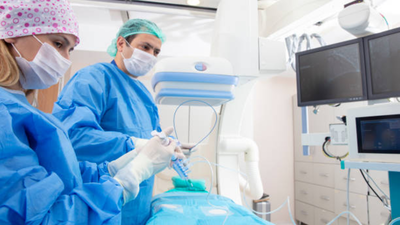
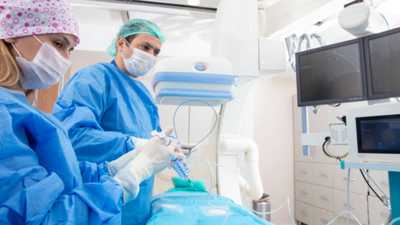
Zone 2 arch aneurysms are tricky. The aorta in this area gives rise to major blood vessels that supply the brain. Any mistake can compromise blood flow to the head and neck. Traditional surgery would have meant opening the chest widely and replacing part of the aorta, a long, physically demanding operation that his lungs simply could not tolerate.So the team, led by Dr. Rohit P V Nair, Senior Consultant – Vascular and Interventional Radiology, decided on something less common but potentially lifesaving: a staged hybrid procedure.First came arch debranching and aortic banding. In simple words, the surgeons rerouted the blood vessels that supply the brain and upper body. They created alternate pathways so that blood flow to the head would remain uninterrupted. Then they placed a surgical band around the ascending aorta. This banding helped create a stable landing zone for the next step, placing a stent graft.Once he recovered from that stage, the second part followed: Thoracic Endovascular Aortic Repair, or TEVAR. Instead of opening the chest again, doctors inserted a stent graft through the blood vessels, guiding it carefully into position. A 36 mm thoracic stent graft, using the Terumo Relay Pro system, was deployed. It was positioned about 10 mm above the debranching site, sealing off the weakened, ballooned section of the artery.The aneurysm sac, which had been under dangerous pressure, was effectively excluded from blood flow.This approach is not routine. It demands coordination between surgical and endovascular teams. But in patients who are otherwise deemed inoperable, it can be the only viable path.
A tough recovery
The surgery went as planned. The relief from the crushing back pain was immediate. But recovery wasn’t instant. His lungs, already fragile, needed time. He spent about four days in the ICU, mainly due to pulmonary complications. Then another ten days in the ward.In total, he remained in the hospital for roughly three to four weeks. Most of that time wasn’t because of the aortic repair itself, but because of his lung infection and past tuberculosis damage. The heart and vessels, in contrast, held steady.Follow-up CT scans brought reassuring news. The stent graft was well positioned. The aneurysm had been successfully excluded. Blood flow to the brain and other major vessels remained intact. There was a mild inner curve endoleak, a small amount of blood flow seen around the graft, but doctors expect it to seal on its own.Aortic arch aneurysms in high-risk patients often come with limited options. Many are told surgery is too dangerous. Others face complications that are hard to overcome.This case shows that sometimes, with careful planning and the right combination of techniques, even complex and high-risk cases can be managed safely.The patient is now back home in Kerala, recovering steadily. His lungs will need ongoing care. His blood pressure must stay under control. And smoking is firmly off the table.Sometimes medicine isn’t about dramatic breakthroughs. It’s about choosing the safest path for the person in front of you. And in this case, that path made all the difference.