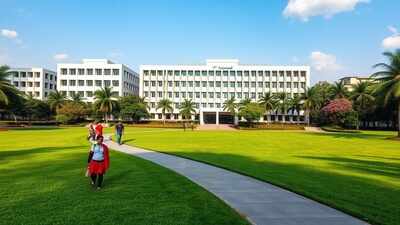
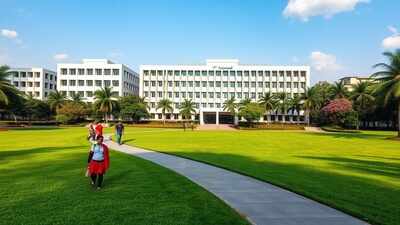
The 2025 Joint Implementation Committee (JIC) report reaffirms the Indian Institute of Technology (IIT) Hyderabad’s growing draw among engineering aspirants. The latest admission data show a consistent rise in candidate preferences across nearly all four-year undergraduate programmes, signalling both academic diversification and an alignment with emerging industry needs.The figures point to a clear pattern: new-age disciplines are catching up fast with traditional favourites.
Computer Science retains the top spot
The Computer Science and Engineering (CSE) programme continues to dominate, attracting 26,572 candidates in 2025, compared to 23,349 in 2024, a 13.8% increase. Its enduring popularity mirrors a national trend, where students are prioritising courses that bridge computing, artificial intelligence, and data science.
Artificial Intelligence strengthens its position
Close behind is Artificial Intelligence (AI), which recorded 23,632 choices in 2025, up from 20,682 in 2024, marking a 14.3% rise. The programme’s rapid ascent reflects IIT Hyderabad’s growing reputation for research-led learning in robotics, machine learning, and automation — areas increasingly favoured by technology firms and research institutions alike.
Biomedical and Industrial Chemistry emerge as fastest-growing
Among all disciplines, Biomedical Engineering posted the sharpest rise in interest: 17.9%, with 8,211 candidates choosing it in 2025 compared to 6,967 last year. The growth suggests a widening fascination with interdisciplinary fields that integrate healthcare innovation with core engineering principles.Similarly, Industrial Chemistry recorded a 16.9% increase, indicating renewed enthusiasm for research-oriented applied sciences.
Electrical Engineering aligns with national semiconductor push
The Electrical Engineering (IC Design and Technology) programme grew by 16.5%, reflecting the broader national emphasis on semiconductor manufacturing and chip design. This aligns with India’s policy-driven focus on strengthening its hardware innovation and microelectronics ecosystem.
Traditional branches remain steady
Core engineering streams such as Mechanical and Civil Engineering continued to draw strong interest, posting growth rates of 13.1% and 13.3%, respectively. Their steady rise reflects sustained confidence in conventional disciplines that remain foundational to India’s industrial and infrastructure sectors.Emerging courses like Computational Engineering, Biotechnology and Bioinformatics, and Engineering Physics also recorded double-digit growth, ranging between 13 and 15%, underscoring IIT Hyderabad’s academic balanc, where legacy disciplines coexist with future-focused offerings.
Student preference trends at IIT Hyderabad (2024–2025)
Here’s a closer look at how each programme fared between 2024 and 2025, based on candidate choice counts from the JIC report.
IIT Hyderabad’s 2025 data paint a picture of evolving academic choices, where traditional engineering continues to hold firm even as data-driven and interdisciplinary fields expand rapidly. The pattern reflects not only shifting student aspirations but also India’s broader economic pivot towards technology, healthcare innovation, and research-intensive manufacturing.