‘Billionaires Day Out’: Elon Musk, Mark Zuckerberg and Jeff Bezos turned into bizarre picture-pooping dogs at Art Basel Miami |
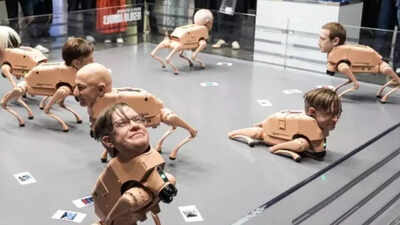
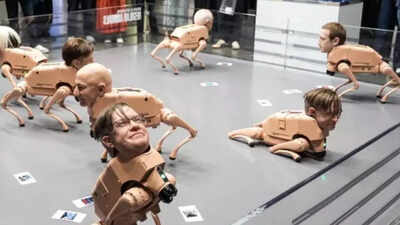
At Art Basel Miami, one of the world’s biggest and flashiest art fairs, a strange group of robotic dogs has become the biggest attraction. These dogs are not ordinary machines. They wear lifelike silicone faces of famous people including Elon Musk, Mark Zuckerberg, Jeff Bezos, Andy Warhol, Pablo Picasso and even the artist Beeple himself. They walk around, blink, and sometimes lean back to “poop” printed artworks. The installation, called Regular Animals, mixes humour, technology and social commentary, and it is almost impossible to walk past without staring.On opening day, crowds gathered around the pen where the robot dogs wandered about. People laughed, filmed on their phones and reacted with shock and confusion. The Musk robot puckered its lips, the Picasso robot gazed into space, and the Beeple robot stopped mid-walk to drop a freshly printed NFT for visitors to take.
Elon Musk and Mark Zuckerberg lead Beeple’s robot pack
Beeple, whose real name is Mike Winkelmann, stood inside the enclosure picking up the printed artworks and handing them to the audience. These prints are not just souvenirs. They are NFTs stored on the blockchain, continuing Beeple’s interest in digital art and how technology shapes creativity.
“They are constantly taking pictures and reinterpreting the world through the lens of these different characters,” Winkelmann explained. Each robot sees the world differently, depending on the style of the person it represents, whether that is Warhol’s bright colours, Picasso’s abstract shapes or the digital influence of tech billionaires.The Musk, Zuckerberg and Bezos robots highlight Beeple’s point about how much power tech leaders have over what billions of people see online. By turning them into robot dogs, he turns that idea into something funny, strange and slightly unsettling.Beeple became world-famous in 2021 when his digital collage Everydays: The First 5000 Days sold for 69.3 million dollars at Christie’s, making him one of the most valuable living artists. The NFT market later crashed, which Beeple himself predicted, saying there had been far too much low-quality work at the time.But digital art has continued to grow. Art Basel’s 2025 report says the field is expanding again, and the fair has a new section called Zero 10 dedicated to digital and tech-based art. This is where Regular Animals has become the most talked-about installation.Visitors reacted in very different ways. Some called it disgusting or disturbing. Others found it brilliant and hilarious. At one point, two real dogs wandered into the area and barked at the robotic versions, which amused the crowd even more.
Robots with a built-in expiry date
Beeple designed the robots with a limited lifespan. Their main function, which is to take photos and turn them into NFTs, will stop after three years. They will still be able to walk, but their creative output will end. It is a reminder of how fast technology ages and becomes outdated.Despite that, all the robots were sold within the first hour of the fair. Soon, small versions of the Zuckerbergs, Musks and Warhols will be living in private homes, occasionally producing NFTs as they move around.
A moment that reflects our digital era
Beeple’s installation captures the strange way art, technology and culture mix in 2025. It is funny, weird and clever, and it forces people to think about how much influence tech giants have over modern life.Beeple’s installation warns, “We are not ready for the future.” Judging from the shocked faces, laughter and constant filming at Art Basel Miami, that message seems to be landing exactly as he intended.