A forgotten US Cold War base resurfaces under Greenland ice in NASA radar scan | World News
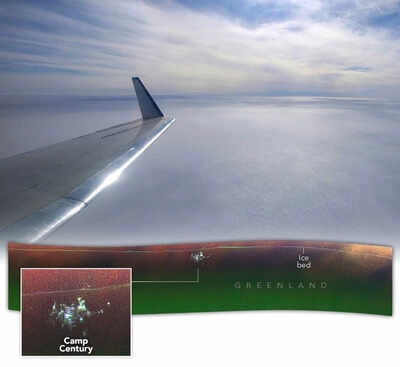
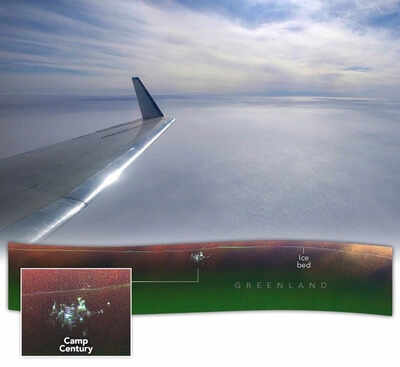
A routine science flight over northern Greenland produced an unexpected image recently. In April 2024, NASA researchers testing a radar system aboard a Gulfstream III aircraft detected a large structure buried deep within the ice sheet. The aircraft was flying east of Pituffik Space Base when the radar signal revealed patterns that did not match natural ice layers. The find turned out to be Camp Century, a long-abandoned Cold War military base constructed beneath the ice in the late 1950s. The detection was incidental and was noticed only after data review. Scientists say the image offers a rare view of a forgotten site and arrives at a time when the stability of the Greenland Ice Sheet is under growing scrutiny.
NASA detects an abandoned Cold War US military base under Greenland ice
The flight was part of a broader effort to test NASA’s UAVSAR system, a radar instrument designed to map ice thickness and internal layers. Unlike older ground-penetrating radar, UAVSAR looks both downward and sideways, producing images with added depth.
As the data came in, researchers noticed unusually straight, parallel features. At first, the signals were unclear. It took comparison with historical maps to confirm that the shape matched Camp Century’s tunnel layout. The radar had effectively outlined parts of the buried base, now sealed under decades of snowfall and ice movement.
Camp Century was built into the ice itself
Camp Century was constructed in 1959 by the U.S. Army Corps of Engineers. It sat more than 200 kilometres east of Thule Air Base on the Greenland Ice Sheet. The base was carved about eight metres below the surface, within compacted snow known as firn.Inside, a network of tunnels housed living quarters, laboratories and support facilities. At its peak, the camp supported up to 200 personnel and ran on a portable nuclear generator. Supplies were hauled over the ice from the coast. The site was meant to test the feasibility of long term military presence beneath the ice.
Cold War plans shaped the Arctic landscape
The base was linked to Project Iceworm, a proposal to hide nuclear missiles under Greenland’s ice. The idea relied on the assumption that the ice sheet was stable enough to preserve structures indefinitely. That assumption did not hold. Ice deformation proved faster than expected. Project Iceworm was abandoned in the early 1960s, and Camp Century ceased year round operations in 1964. The site was fully abandoned by 1967, with most infrastructure left in place.
Ice accumulation buried the base deeper each year
After abandonment, snowfall continued to build over the camp. Today, its remains lie at least 30 metres below the surface. Over time, tunnels collapsed and structures were compressed by the weight of ice above.Previous radar surveys had detected hints of the camp, appearing as distortions within ice layers. The new UAVSAR data, however, shows individual features more clearly. Researchers say the added dimensional view makes the structures visible in ways not previously possible, though it also complicates interpretation.
Climate change gives the discovery new weight
When Camp Century was built, the Greenland Ice Sheet was thought to be largely immune to surface melting. Since then, understanding has shifted. Measurements show sustained ice loss throughout the twentieth century, with faster losses since the 1990s.According to research titled “The abandoned ice sheet base at Camp Century, Greenland, in a warming climate”, between 2007 and 2011 alone, Greenland lost more than 260 gigatonnes of ice per year on average. Researchers have linked most of the ice loss in the drainage basin downslope of Camp Century to increased surface melting, not glacier flow. These trends raise questions about what could eventually happen to material buried within the ice.
Buried waste remains part of the concern
When Camp Century was abandoned, little decommissioning took place. Aside from the nuclear reactor core, which was removed, waste materials were left behind. These include biological, chemical and low-level radioactive remnants.Scientists use radar data to estimate how deep the site lies and how ice movement might affect it in the future. While there is no immediate risk, the possibility of re exposure over long timescales remains part of ongoing research.
A chance image with limited immediate purpose
The radar image of Camp Century was not the goal of the mission. Researchers were focused on understanding how UAVSAR performs over ice. The image remains, for now, more of a curiosity than a tool.Still, the data helps refine methods that will be used in Greenland and Antarctica. Measuring ice thickness accurately remains essential for projecting sea level rise. Camp Century, frozen into the ice, has resurfaced briefly in the data, then settled back into the background, where it has been for decades.