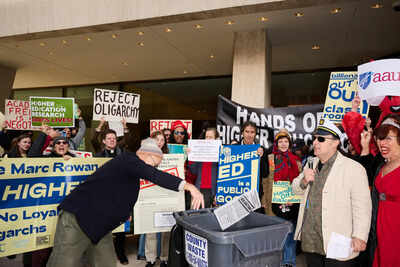
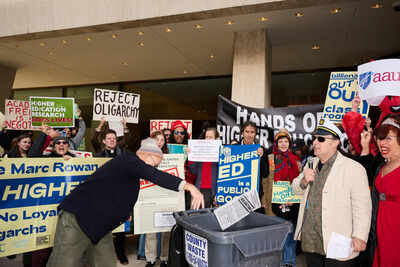
Across the East Coast on Friday, more than 70 professors and students took to the streets of Midtown to protest the involvement of billionaire investor Marc Rowan in President Donald Trump’s controversial higher education compact. The demonstration was one of over 100 events held at US campuses as part of the National Day of Action for Higher Education, organised by the American Association of University Professors (AAUP).
A clash over influence in higher ed
The rally, held outside Apollo Global Management’s headquarters, brought together AAUP members from NYU, Columbia University and the University of Pennsylvania. Participants called for Rowan, founder of Apollo and a Trump donor who contributed to the compact’s creation, to refrain from influencing university policies. The protest began with speakers highlighting the role of billionaires in turning universities into ideological arenas, while a small police presence monitored the event. Demonstrators carried signs demanding “No Compact, No Loyalty Oath, No Oligarchs” and called attention to the diversion of resources from education, WSN reports.Earlier in the week, Apollo had advised around 1,000 employees to work remotely during the protests. Andrew Ross, a CAS professor and AAUP member, told WSN that the university community opposed external interference in higher education, emphasising that billionaires had no place shaping institutional values.
The compact at the centre of controversy
The protest follows the Trump administration’s invitation to a select group of universities to sign a compact that financially rewards institutions for ending diversity hiring, freezing tuition for five years, and capping international undergraduate enrolment at 15%. While two colleges have agreed to participate, seven of the nine initially contacted declined.In October, AAUP members held a town hall at NYU to encourage universities to publicly reject the compact. They also proposed organising what they described as “the biggest mass-organising event for higher education” in US history on May Day 2026, signalling the scale of the resistance to perceived external interference.
A broader political and institutional context
Rowan, a Penn alumnus, has previously supported initiatives that intersect with university governance and campus politics. He was part of a coalition that influenced a 2019 executive order under the Trump administration classifying “targeting of the state of Israel” as antisemitic, a policy that critics argue disproportionately affected pro-Palestinian students. NYU adopted the definition in 2020 as part of a settlement and updated its conduct guidelines in 2024 to include certain “code words” under nondiscrimination policies.In March, Trump’s antisemitism task force threatened to investigate NYU and potentially cut funding, although no formal action appears to have been taken. On the same day as the protest, Cornell University agreed to a $60 million settlement over allegations of diversity-related practices in admissions, also committing to annual surveys of Jewish students to monitor campus climate, according to WSN.
Student activism and institutional accountability
Students, including members of NYU’s Students for a Democratic Society, staged a walkout at noon demanding that the university formally reject the compact and end what they called compliance with the Trump administration. They also criticised NYU Langone Health’s denial of gender-affirming care to transgender patients earlier this year. WSN reports that students expressed concern that institutional decisions were increasingly guided by financial incentives rather than principles.David Markus, CAS professor and AAUP member, told WSN that faculty, students and staff would continue to mobilise in defence of the free pursuit of knowledge, highlighting the responsibility of administrators to uphold a vision of higher education as a public good rather than allowing external interests to shape institutional direction.
Looking ahead
Friday’s protests raise questions about governance, academic freedom, and the future of university policy in the United States. As the AAUP continues to coordinate national actions, institutions are increasingly being asked to weigh profit and political alignment against principles of inclusivity and academic independence.