European companies tell European Union what American tech companies have been trying to: We are not truly in the position to … |
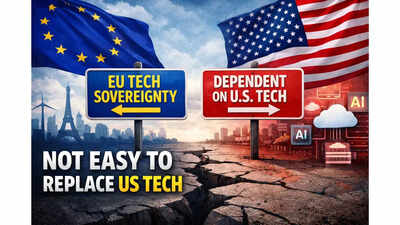
European companies have reportedly warned the European Union against rapidly reducing reliance on American technology providers. A report cited European companies to claim that “tech sovereignty” in the region could be difficult to achieve quickly without affecting business operations. According to a Financial Times report, EU-based companies across sectors, including banking and manufacturing, have said their dependence on US technology platforms cannot be easily replaced. This report follows the US issuing a similar caution to Europe earlier this year. Sean Cairncross overstated concerns about Washington interfering with Europe’s internet infrastructure during his speech at the Munich Security Conference in February. The idea that the US government could shut down internet access in Europe is not “a credible argument,” he said. At that time, he also noted that, “It’s China you should worry about, not us.”The concerns come as the EU pushes for greater “tech sovereignty” and explores ways to reduce reliance on US companies. Business leaders say shifting away from widely used tools such as cloud infrastructure, office software, and emerging artificial intelligence (AI) services could lead to disruption if changes are made too quickly. The warnings come as Europe’s efforts to strengthen digital sovereignty have gained attention recently, partly driven by concerns that US President Donald Trump‘s foreign policy could lead to a “tech decoupling” between the US and Europe. The European Commission is expected to present a “tech sovereignty package” next month aimed at expanding sovereign cloud services and strengthening Europe’s independence in software technologies.
Why are European companies concerned about rapidly reducing dependence on US companies
In a statement to FT, Ilse Henne, CEO of supply chain manager Thyssenkrupp Material Services, said, “In Europe today we are not truly in the position to substitute all our IT solutions . . . with European solutions.” She added that companies would need significant investment and political support to shift away from US technology providers.Executives at several European technology and infrastructure companies, including ASML, Ericsson, and Capgemini, have also cautioned against protectionist measures that could increase costs and slow investment.Some European companies argue that policymakers underestimate the operational challenges and costs involved in shifting away from existing technology providers. Businesses say this is particularly difficult as European industries already face pressure from competition in China, high energy prices, and uncertainty around transatlantic trade.Commerzbank said the “range, quality and technological maturity of services” provided by US companies such as Microsoft and Google are currently available only to a “limited extent” within the European market.“As a result, the benefits of using these providers at this point in time outweigh the inherent risks associated with doing so,” the bank told FT.A European carmaker also said moving away from existing infrastructure would require additional time and investment. Many European companies, especially those with international operations, have built their digital systems on US platforms. According to businesses and industry experts, replacing those systems would involve retraining employees, rewriting software, renegotiating contracts, and managing operational disruptions. Several companies also say comparable European alternatives remain limited.Multinational companies have spent decades building their processes, productivity, and “sometimes even their business model on tech bricks that come from the US,” said Francesca Musiani of the French National Centre for Scientific Research.She noted that private companies find it harder to justify decisions based on sovereignty or national security if the alternatives increase costs or reduce performance. “They are in a global competition logic where any operational slowing down can be translated into losing market share,” Musiani added.Deutsche Bank said its partnerships with global technology companies reflect the need to support clients worldwide. The bank also said it works with technology firms in Germany, Europe and Asia.In its latest annual report, Deutsche Bank warned that the financial sector’s growing dependence on a small group of global cloud and data-centre providers, many based in the US, could increase concentration and systemic risks.“Banks continue to rely on US hyperscalers because this is where scalability, resilience and speed of innovation are currently the most industrialised,” said Alexander Schroff of Publicis Sapient.The discussion around technology sovereignty has also raised concerns about a possible “kill switch” scenario in which the US government could require American technology companies to suspend services to European customers through sanctions, export controls, or other legal measures.While many executives consider this scenario unlikely, it has become a topic of discussion in boardrooms and government meetings.US technology companies have tried to reassure European clients that their services would remain available regardless of potential policy decisions in Washington. Some companies have proposed sovereign cloud offerings and partnerships with European firms.Deutsche Telekom said it was “actively promoting sovereignty” through platforms such as T Cloud Public and Industrial AI Cloud. A spokesperson said, “We know we will also rely on foreign technologies.”One European carmaker said technological sovereignty should be considered primarily for future initiatives, such as AI, rather than for existing business operations.Some policymakers and analysts in Berlin have proposed that Europe should prioritise the implementation of foreign AI models over the construction of competing cloud infrastructure, due to the significant financial investment involved.One German government official described the issue as a “trade-off” between sovereignty and competitiveness. European companies, the official said, need to focus on “applying the best available AI models over the next three to four years” to remain competitive against companies from China and the US.Meanwhile, industry groups representing US technology companies argue that Europe’s push for sovereignty could risk moving toward protectionism.“We shouldn’t confuse digital sovereignty with digital solitary confinement. Walling Europe off won’t make it safer or more independent, it will just cut us off from global innovation,” said Alexandre Roure of the Computer & Communications Industry Association.Michael Kratsios said last month that real AI sovereignty “does not mean waiting to participate in an AI-enabled global market until you have tried and failed to build full self-sufficiency”.Some business representatives have also warned that Europe should first address structural challenges that would help local technology alternatives develop, such as strengthening the single market, reducing regulatory complexity, and expanding access to capital.Europe should avoid falling into a “hyperscaler trap” by trying to replicate large technology companies from Silicon Valley, said Martin Hullin of the Bertelsmann Stiftung. Instead, he suggested building broader technology ecosystems to support future innovation.“There are very interesting opportunities, but only if Europe plays its cards right with the right industrial policy tools,” Hullin said.