
Forget king cobras: Greece unearthed a 26-kilogram viper snake that weighed three times |

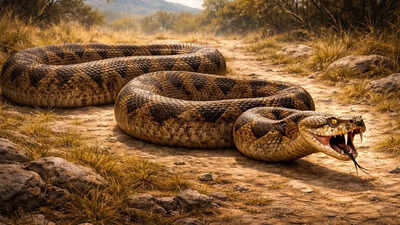
When people consider the most massive venomous snakes on the planet, the king cobra is generally the first species that comes to mind. This is because it is well-known for its enormous length and its reputation as a deadly serpent. Nevertheless, fossil evidence indicates that an ancient snake that was discovered in Greece could have been more impressive in terms of its sheer mass.The prehistoric viper that was discovered in Greece is called Laophis crotaloides. This ancient snake was believed to have lived millions of years ago and could have been the most massive venomous snake that has ever been discovered. This prehistoric viper weighed around 57 pounds and was around 10 to 13 feet long. While the details of the prehistoric viper that was discovered in Greece are still unknown, the discovery provides an interesting insight into an era when massive predators were roaming parts of Europe that look quite different today.
The discovery of an enormous prehistoric viper
The history of this giant snake starts from 1857, when British palaeontologist Richard Owen decided to study fossil remains found in the region around Thessaloniki in northern Greece. As you know, Owen is famous for his discovery of dinosaurs. He found some fossilised vertebrae belonging to an unusually large snake. Owen determined that this snake was a type of viper due to its vertebrae shape and size. He named this species of snake Laophis crotaloides and determined that this venomous snake was enormous in comparison to other living vipers. Not many vertebrae were found, and that is unfortunate because scientists had limited material to analyse. Nevertheless, these vertebrae indicated that this snake had an exceptionally massive body.
How big was the Greek viper really
Laophis crotaloides is estimated to have been between 10 and 13 feet long and weighed 57 pounds. Although a king cobra can be longer, up to 18 feet at times, it is also much more slender. Most king cobras that are long are only 20 pounds or less in weight, which means that the ancient Greek viper could have been as much as three times as heavy. However, there is a biological fact that needs to be mentioned. The length of a snake is not necessarily a gauge of its size or strength. A heavier snake is a more muscular snake.
Why the king cobra is still famous today
Despite the discovery of this prehistoric species, the king cobra is still the longest venomous snake that exists today. The king cobra is well-known throughout Asia due to its menacing hood, potent venom, and its capacity to feed on other snakes.The king cobra’s body is rather slim compared to the vipers. Its design is more suited for speed rather than bulk.The Greek viper could have been designed more like a heavyweight snake, shorter and thicker.
The environment where this giant snake lived
Laophis crotaloides is believed to have lived about four million years ago during the Pliocene period. The area that is now northern Greece had a landscape that could provide a habitat for large predators like this viper. The area had grassland and dense vegetation. The climate was also cooler than that found in tropical areas where large snakes are found today. It is interesting to consider how this large reptile adapted to its environment, as snakes today rely on a warm environment to regulate their body temperature.The way that this viper lived is still a mystery to scientists.
Why scientists still debate this snake
While this was a remarkable discovery, it came with its own set of challenges. For one, only a handful of fossil vertebrae were initially found, while the rest of the skeleton was not recovered.For decades, this species remained a bit enigmatic because scientists did not have enough proof to fully validate its characteristics. Some experts were even doubtful whether these fossils were actually from a giant viper.However, scientific studies carried out later revived the interest in the species. A study published by the Swiss Journal of Geosciences in 2016 re-examined the fossil material associated with Laophis crotaloides and examined a new vertebra found in northern Greece. The study reinforced the suggestion that the fossil was from a large extinct viper from the Pliocene epoch, thus supporting earlier claims that it may have been one of the largest vipers found in Europe.Even though scientists still have much to learn about Laophis crotaloides, the fossil remains show that prehistoric wildlife could be far more surprising than we imagine.