Indian schools embrace AI: Are teachers ready for the shift?
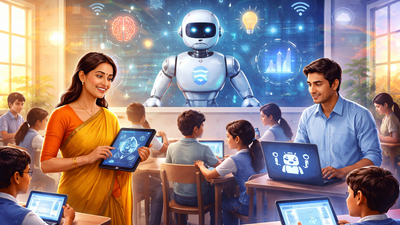
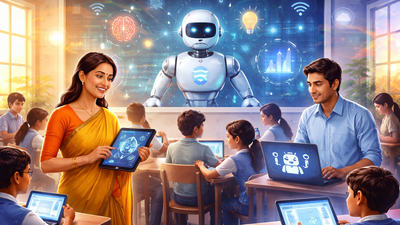
Over the last few years, technology has stopped sitting at the edge of Indian schooling. It has moved into the middle of the pedagogy conversation. NEP 2020 pushed that shift. When it spoke about digital literacy and computational thinking, it was setting a long-term direction. The message of the policy was that technology will no longer be limited to an isolated computer period or an ICT lab. Now, it has to start shaping how subjects are taught and how students practise. The first visible curriculum step came in the senior classes. CBSE introduced Artificial Intelligence as a Skill subject for Classes IX and X. Students could opt for it formally. They could learn the basics, create projects, and work through the AI project cycle. Now the shift is moving earlier.The government aims to introduce AI and Computational Thinking from Grade 3. Now, that changes the starting point. It is no longer a change meant only for teenagers who have learnt to code. It begins at the primary level. Any curriculum reform, however, does not travel on circulars or frameworks alone. Teachers are the backbone of any pedagogical shift.
How AI-ready are our teachers?
For AI to be inculcated successfully in everyday learning, the first pre-requiste is well-trained educators. Now, here is the real question: Are our teachers ready for the big AI shift in Indian classrooms? According to a 2025 nationwide survey by the Centre for Teacher Accreditation (CENTA), nearly 75% of teachers reported using AI resources actively. Lesson planning happens to be their number one use case. Around 26% of survey participants said they use AI to generate classroom activity ideas.But here is the catch. The same survey also flagged a gap between confidence and clarity. While 67% of respondents rated their AI expertise at 6 or higher on a 10-point scale, and the average self-rating was 7 out of 10, only 57% could correctly answer a basic misconception question on AI posed by CENTA.
Microsoft’s teacher training push
Against this backdrop, Microsoft has launched its ‘Elevate for Educators’ programme in India, the first country in Asia. The tech giant plans to train two million teachers in Artificial Intelligence skills by 2030. The rollout begins with all 75 CM SHRI schools in Delhi. That makes Delhi the first full implementation site.India has close to 10 million teachers across school education. If the target is met, roughly one in five educators will be part of the programme over the next five years. Microsoft also plans to ensure that the initiative reaches up to 200,000 schools and institutions.
How the programme is structured
Microsoft’s India note describes Elevate for Educators as a framework built on three core pillars: Credentials, Community and Capacity.Put simply, it is a teacher training programme that prioritises usage of AI tools in education. This initiative is not part of a curriculum change, rather, it is aimed towards professional development.As part of the Credentials pillar, Microsoft plans to roll out new AI-related certifications for educators. These certifications are in line with national education standards as well as the AI literacy guidelines. Designed to arm teachers with a better understanding of AI tools, helping them plan better and improve student engagement in class, this programme is available to educators across schools, skill institutes and higher education. However, operational details such as training hours, exam assessment and success matrices haven’t been detailed out yet.The second pillar happens to be Community. The initiative is an effort to offer a shared platform to a community of 2 million teachers and equip them with a strong peer-learning network where they can collaborate, exchange practices and support each other while adopting AI tools. The idea is to foster long-term engagement and not a one-time training cycle. The third and a crucial pillar of the programme is Capacity. Here, Microsoft will help create AI Ambassadors, Educator Academies, AI Productivity Labs and Centres of Excellence across 25,000 institutions. The aim is to build “AI readiness” before large-scale classroom use.
Delhi teachers are embracing AI
In Delhi’s CM SHRI schools, AI is entering the classrooms through teachers’ prep work. Fatima, who teaches at the CM SHRI school in Rohini’s Sector 11, told TNN that she used Microsoft Copilot for preparing a Class XI biology lesson. The tool, she revealed, helped her quickly put together posters, infographics and a structured presentation, with the learning goals laid out clearly. According to her, concepts that earlier took long explanations can now be broken down into smaller steps that students find easier to follow.In an interaction with TNN, Madhubala, another teacher at a CM SHRI school in Dwarka, shared how she used Copilot to support a student with autism. She created customised motivational stickers and simple feedback tools so the child felt more at ease during class, said Madhubala.Language learning is another area where teachers find AI to be beneficial. Preeti Sharma, another educator from Rohini, told TOI that the tool helps her simplify abstract ideas in English lessons. She said it also helps her push students beyond straightforward answers, nudging them towards skills like inference and prediction.
Scale vs. substance
Microsoft’s plan to train two million teachers sounds impressive. But teacher training in India has historically struggled with depth and continuity. While workshops are organised and certificates are issued, sustained handholding for improved efficiency is not something that gets its due importance. There are also harder questions too, the ones that policy notes do not always linger on. Defining what responsible AI use looks like in classrooms, setting guardrails to prevent misinformation, and recognising the ethical, pedagogical and practical nuances involved are challenges far too complex to be addressed through ambition alone. Also, unequal access is a reality, too glaring to ignore. Evolved urban schools will be quick at experimenting and adapting. On the other hand, rural schools, where basic infrastructure is still an insurmountable challenge, adoption of AI and training teachers seem to be difficult, to say the least. If teacher readiness is uneven, AI risks widening the very learning gaps it claims to reduce. What remains to be seen is whether or not the promised scale translates into depth on the ground, especially for teachers in resource-constrained schools.