
First-of-its-kind mission: US airlifts next-gen nuclear reactor on C-17 aircraft — watch how it was done
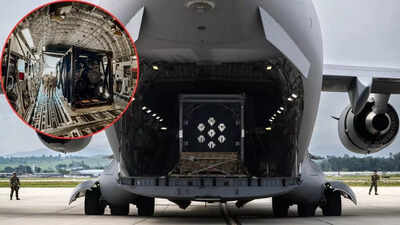
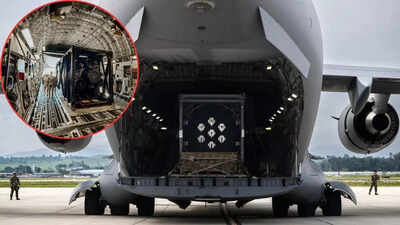
The United States on Monday airlifted a miniature nuclear reactor for the first time using a C-17 Globemaster III aircraft, marking a new step in rapidly deployable nuclear energy systems.Officials described it as “The first-ever airlift of a nuclear reactor and ancillary systems via C-17, opening a wide aperture for strategic nuclear deployment around the World”.Three C-17A Globemaster III aircraft from the US Air Force’s 62nd and 437th Airlift Wings transported eight nuclear modules on Sunday. The mission was part of a joint Department of Defense and Department of Energy initiative called Operation Windlord.The aircraft carried the unfuelled components of the Valar Atomics Ward 250 reactor from March Air Reserve Base in California to Hill Air Force Base in Utah. The modules will later be moved to the Utah San Rafael Energy Lab in Orangeville for testing under the Department of Energy’s Nuclear Reactor Pilot Program. The programme was created following President Donald Trump’s Executive Order 14301.
The Ward 250 is a 5 megawatt reactor designed to fit inside a C-17 aircraft. Company officials said testing will begin at 250 kilowatts and the system can eventually produce 5 megawatts. The reactor could theoretically power about 5,000 homes.The reactor uses TRISO fuel, which consists of uranium kernels encased in ceramic layers, and helium coolant instead of water. For military use, such systems could provide energy security at bases and reduce dependence on the civilian power grid.The airlift comes as President Donald Trump pushes to expand nuclear power and strengthen military base energy security. On May 23, 2025, he signed four executive orders aimed at advancing America’s nuclear energy posture, including measures to “Reinvigorating the Nuclear Industrial Base” and “Deploying Advanced Nuclear Reactor Technologies for National Security”.At March Air Reserve Base, officials linked the initiative to national security. “Energy is not just an economic issue, although it is that, it is a national security issue as well,” said Utah Governor Spencer Cox. He added, “America cannot project freedom if we lack reliable deployable power at home and in the field”.Michael P Duffey, the undersecretary of war for acquisition and sustainment, stressed coordination between departments. “It’s clear to me that advancing President Trump’s priority on nuclear energy depends on close coordination between the Department of Energy and the Department of War,” Duffey said. “This partnership ensures advanced nuclear technologies are developed, evaluated and deployed in ways that strengthen energy resilience and national security”.He also spoke about the military implications. “Powering next generation warfare will require us to move faster than our adversaries, to build a system that doesn’t just equip our warfighters to fight, but equips them to win at extraordinary speed,” Duffey said.Energy Secretary Chris Wright called the move part of a broader revival of the sector. “The American nuclear renaissance is to get that ball moving again, fast, carefully, but with private capital, American innovation and determination,” Wright said. He added that by July 4, 10 small reactors will be critical, calling it “the start of a nuclear renaissance”.The Boeing C-17 Globemaster III is one of the US Air Force’s primary strategic airlift aircraft. It can carry more than 70 tonnes of cargo, including heavy military equipment. It can operate from short and austere runways and allows rapid loading and unloading through its rear ramp.The operation is being seen as a shift towards modular nuclear systems that can be transported quickly. It signals that compact reactor modules can be moved across states and potentially across continents, giving the US greater flexibility in deploying nuclear energy infrastructure.