A stream of hope flows in Bundelkhand through ‘Har Ghar Nal’ | India News
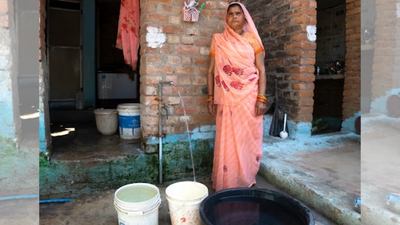
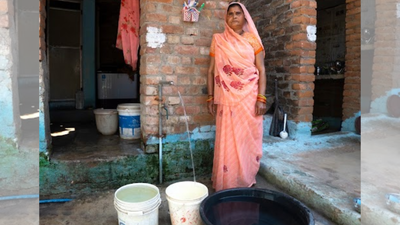
LUCKNOW: For the people of Bundelkhand, this is nothing short of a dream come true that water is now available inside their homes. There are countless stories of hunger, poverty, and hardship linked to water scarcity in this region.The image of a woman carrying a pot of water on her head from faraway places had, for years, become the very identity of Bundelkhand’s districts.For decades, women here endured the water crisis. They walked long distances to reach remote wells and stood in queues at handpumps to collect water. But all this is now part of the past. Today, water tanks visible from afar stand as flowing streams of hope.This scene in Bundelkhand can captivate anyone. In Marwari Gram Panchayat of Panwari block in Mahoba, a woman adjusts her veil outside her house and fills a bucket with water from a tap, while a six-year-old child stands nearby holding a glass. The happiness on the woman’s face says everything about what this tap means to her.When asked, she replies shyly, “Brother, a big crisis has been removed.” When asked whether water comes regularly, her enthusiasm is evident. “Yes, why not. It comes every day.”When asked who all have tap connections, the village head standing nearby explains in detail, “Everyone in the village has it. Water comes twice a day. One tap connection is public, where anyone passing by can drink water.”Talking about Mahoba, the people here had long endured extreme hardship due to water scarcity. At one point, water had to be supplied through water trains. People wandered far and wide just to fill a single pot of water. Now, water tanks visible from a distance tell a completely new story.Under the Jal Jeevan Mission, through five projects, pipeline connectivity has been provided to more than 1.12 lakh households in the district. However, this large-scale scheme did not take shape easily. About 1,131 kilometers of roads were damaged during the work. While repair work was carried out, people did face some inconvenience.Arshad from Mahoba says that whenever a scheme begins, some inconvenience is inevitable, but “Har Ghar Nal” has emerged as a very big hope for this region.In Chitrakoot, under the Silauta Gram Mustakil Group Scheme, the water problem of about 1.25 lakh people in the development blocks of Pahadi, Ramnagar, and Manikpur has been resolved. The hardship of Manikpur’s residents can be understood from the fact that they earlier had to bring water from nearly one kilometer away.Because of this problem, people were often reluctant to marry off their daughters. For them, this water means life itself and the future of their children.Under the scheme, a total of 576 km of pipeline was planned, of which 572 km has already been laid. There are 17 overhead tanks, where water is brought daily from the water treatment plant. Water is drawn from the Yamuna River, treated at the plant, lifted into tanks, and then supplied to people’s homes.Smt. Rajjan Devi, the village head of Barhat, becomes emotional while talking about this scheme. She says, “We are grateful to the Yogi-Modi government for making arrangements to protect our children from diseases. Our children now bathe and go to school. A sense of cleanliness has automatically developed in them.”Along with Silauta, Raipura and Chandi Bangar group drinking water schemes are also being implemented in Chitrakoot. These schemes represent streams of hope that people had never even imagined.Under the Raipura Gram Samuh Peyjal Yojana, the target was to provide tap water to 19,570 families. Taps have been installed in all these houses, and water supply has begun in 60 revenue villages.Chunbad Yadav, a resident of Madna village covered under the scheme, says that a major problem has been resolved. Arranging water even for daily use was difficult earlier, and water for livestock was out of the question. Now they no longer have to worry.This may appear to be just about a tap, but for Bundelkhand, it is a blessing. It represents the fulfillment of a resolve that the Modi-Yogi government undertook as a mission.In Jhansi district, Jal Jeevan Mission pipelines have reached even the last-mile villages in Bada village, Chirgaon, and Bangra.Kamta Prasad, a 65-year-old resident of Gairaha Gram Panchayat in Bangra block, becomes emotional and says that his eyes had longed to see this day.Shagun, a married woman from this village located far from the district headquarters, says ‘earlier she had to walk half a kilometer outside the village to fetch water, and the situation became extremely difficult during the rainy season’.In Pachwara Gram Panchayat of Bangra block, when Ragini came as a daughter-in-law, she had to fetch water from a government handpump. Today, she proudly turns the tap and shows how clean the water is.The daughter-in-law of a poor family is happy that her husband Mukesh Kumar, a daily wage laborer, did not have to pay even a single rupee for the tap connection.Village head Akhilesh Rawat says, ‘about one thousand connections have been provided in his village’. In this Dalit-dominated village, the Arogya Mandir built during the Yogi government also has a tap connection under the Jal Jeevan Mission, ensuring clean drinking water for patients and attendants. Government schoolchildren are also now drinking clean water.Executive Engineer of the Jal Jeevan Mission, Ranvijay Singh, says that 42 villages are covered under this scheme, with 11,437 connections provided.Earlier, the very mention of Banda would bring to mind drought, water scarcity, and thirst. Now, through the Amlikaur Drinking Water Project and the Khatan Drinking Water Project, water has reached 544 villages, and 82,266 households have been provided connections.Pardeshi, a resident of Bandha Purwa village in Badokhar Khurd block says, ‘earlier they struggled a lot for water, but now they are receiving clean water inside their homes’.Executive Engineer of Jal Nigam, Vimal Kumar Verma says, ‘that roads dug up for pipeline laying have also been repaired’.In Hamirpur district as well, two drinking water projects are underway, through which tap water is being supplied to homes in 320 out of 322 villages. For the people here, this scheme is set to play a very significant role in transforming daily life.