Vaishnaw: India in 1st league of AI nations, not a follower | India News
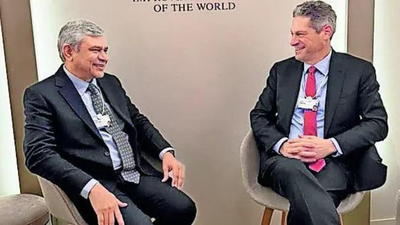
NEW DELHI: IT minister Ashwini Vaishnaw has pushed back on IMF’s comment of the country being a secondary AI power, positioning itself as a front-rank AI nation by focusing less on headline-grabbing large models and more on large-scale deployment.At a panel discussion at the World Economic Forum annual meeting in Davos, Vaishnaw challenged the view that India sits in a secondary tier of AI powers. “Actually, clearly in the first group,” he said, arguing that the country is simultaneously building capability across all five layers of the AI stack – applications, models, chips, infrastructure and energy.The minister said the real economic value of AI did not lie in building ever-larger models but in enterprise-level deployment. “ROI (return on investment) doesn’t come from creating a very large model; 95% of the work can happen with models which are 20 billion or 50 billion parameters,” he said, adding that India has a bouquet of such models deployed across sectors to improve productivity and efficiency.He also questioned the assumption that ownership of large frontier models translates into geopolitical leverage. “Does creating a large model give you geopolitical power? I don’t think so,” he said, noting that such models can be switched off and may even become financially unsustainable. “The economics of this fifth industrial revolution is going to come from ROI – deploying the lowest cost solution to get the highest possible return.“A key constraint, he said, is access to compute. To address this, India has empanelled around 38,000 GPUs under a public-private partnership model to create a common national compute facility. The system is govt-enabled and subsidised, allowing students, researchers and startups to access compute at roughly one-third of global costs.Outlining India’s broader approach, the minister said the focus is on four pillars: a shared compute facility, a free bouquet of practical AI models, large-scale skilling with a target of training 10 million people, and helping the IT services industry pivot towards AI-driven productivity.On regulation, he stressed the need for a techno-legal framework rather than laws alone. “Detecting deep fakes with the accuracy which can be taken to a court and be properly judicially checked” is essential, he said, adding that India is developing tools to mitigate bias and ensure proper unlearning before enterprise deployment.