It’s not about Gaza: Is UN real target of Trump’s Board of Peace? China emerges as unlikely defender
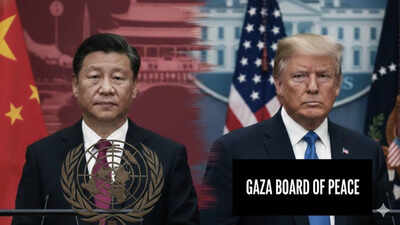
China on Wednesday said it will defend the UN system after receiving an invitation to join the Gaza Board of Peace.Beijing said a day earlier that it had received the invitation from the US for the coveted membership of the board, but it hasn’t said whether it will join.Foreign ministry’s spokesperson told a news conference on Wednesday that Beijing supported a ‘UN-based’ world order regardless of changes.“No matter how the international situation may evolve, China will firmly uphold the international system with the UN at its core, the international order based on international law, as well as the basic norms guiding international relations, which is based on the purposes and principles of the UN Charter,” it said, as quoted by China Daily.Responding to a question of whether the Chinese government “welcomes” the current “chaos” and divisions in the West, it said China was always committed to remaining “a positive and stabilising force for the good”.“We don’t intend to, and will not compete for influence with any country,” it said, adding that upholding the international system with the UN at its core is “in line with the interests of all countries”.China is among the countries offered a seat at the Gaza Board of Peace by US president Donald Trump at a cost. The board, conceived to oversee the ceasefire between Israel and Hamas in Gaza, is reportedly being envisioned by Trump as playing a role in other global conflicts as well.If the Board of Peace were to eventually supersede the United Nations, China could risk losing the influence it currently holds as a permanent member of the UN Security Council, where its veto power gives it significant leverage over international peace and security decisions.
What is Board of Peace?
The Board of Peace, led by US President Donald Trump, was initially proposed as a small group of world leaders tasked with overseeing the ceasefire between Israel and Hamas in Gaza. Since then, the concept has expanded, with the Trump administration inviting dozens of countries and signalling that the board could take on a wider role in addressing global conflicts.While the board’s final charter has not been made public, invitation letters sent by Trump to world leaders, described the board as a “bold new approach” to resolving international conflicts, with language that suggests it could function alongside or in competition with the UN Security Council. The draft remains under revision and is not final, US officials have said.Under the charter, the chairman, a role Trump has said he would assume, would have the authority to invite member states, cast tie-breaking votes, determine the frequency of meetings, and create or dissolve subsidiary bodies.The draft indicates that member states would fund the board, serve fixed terms, and that large financial contributions could secure permanent membership.
Can Board of Peace replace UN?
Critics of the United Nations argue that the body has increasingly struggled to act decisively on major global conflicts due to veto power within the Security Council, deep divisions among permanent members, and slow consensus-building. Wars in Gaza, Ukraine and elsewhere have once again highlighted limits to the UN’s enforcement powers. The United Nations Security Council, however, has formally endorsed the board through a US-drafted resolution adopted in November, granting it international legitimacy.Trump’s estrangement from existing multilateral institutions, including the US withdrawal from the World Health Organisation and the Paris Climate Agreement, reinforces concerns that Washington is increasingly favouring alternative frameworks outside established global bodies.The United Nations was conceived and led by the United States and its allies after World War II to prevent future global conflicts, promote collective security, and uphold international law. Given that the United Nations was established under US leadership and evolved over time through broad international consensus, the Board of Peace would require similar levels of multilateral buy-in, institutional clarity and sustained participation before it could expand beyond a limited mandate or assume a wider global role.