
This blue planet possibly resembling Earth experiences rain of glass at 5400 mph, says NASA |
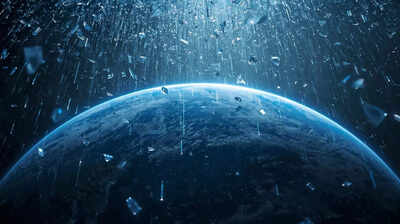
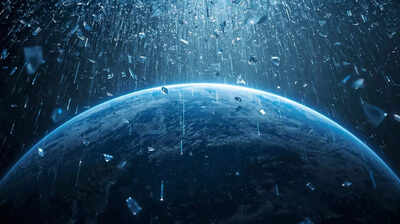
HD 189733 b orbits so close to its star that distance almost stops mattering. The planet was logged in 2005, one of many large gas worlds found tucked tight against their suns. Over time it drew attention for reasons that were not obvious at first. It looks blue when seen through space telescopes. That colour lingered in early reports, sitting awkwardly beside measurements that suggested extreme heat and constant exposure. The planet is a little larger than Jupiter and circles its star in just over two days. Those numbers alone do not explain much. What made the planet useful was how often it showed up in data, again and again, offering clues about what happens when an atmosphere is pushed beyond familiar limits.
Rain may fall as glass through violent winds on HD 189733 b
At first glance the colour seems almost calm. Blue, in planetary terms, tends to invite easy comparisons. However, with HD 189733 b, that initial perception quickly changed. Closer study pointed away from water and toward haze. High above the planet, clouds appear to be made of silicate particles, materials closer to glass than vapour. These particles scatter light in a way that favours blue wavelengths. The effect is subtle but consistent. Nothing below those clouds resembles a surface. The colour belongs to the atmosphere alone, shaped by light and suspended matter rather than anything solid.
Extreme heat dominates the planet’s atmosphere
Heat is present everywhere on HD 189733 b, though not evenly. Estimates place daytime temperatures near 2,000 degrees Fahrenheit, high enough to disrupt most stable chemistry. The planet is tidally locked, so one side faces the star without relief while the other stays in partial darkness. That arrangement creates contrast rather than balance. Energy moves through the atmosphere quickly, never fully settling. Some molecules survive only briefly before breaking apart. Others reform under different conditions. The atmosphere appears restless, always adjusting, never close to equilibrium.
Violent winds are driven by sharp temperature contrasts
Wind patterns on the planet are inferred rather than observed directly, pieced together from shifts in heat and light. The speeds suggested are difficult to picture, running into thousands of miles per hour. Gas heated on the day side moves rapidly toward cooler regions, pulled by pressure differences rather than rotation alone. The motion seems global, not confined to narrow bands. Particles caught in these flows would not linger. They would be carried around the planet quickly, adding to the sense of constant movement that defines the atmosphere.
Silicate particles form glass like rain in the atmosphere
The phrase glass rain has stayed in circulation partly because it captures attention and partly because it is not entirely wrong. In the upper atmosphere, silicate material can vaporise and later condense into small solid fragments. These fragments do not fall gently. Strong winds push them sideways, scraping through layers of gas. It is a process inferred from temperature, composition and motion rather than directly witnessed. Still, the idea fits the conditions. Any object passing through would face steady abrasion rather than sudden impact.
HD 189733 b remains a key target for exoplanet research
The planet continues to appear in studies because it is cooperative in a way. At roughly 64 light years away, it is close enough to allow repeated measurements. Telescopes like Hubble and Spitzer have returned data that can be compared over time. Researchers use it to test how atmospheres behave under stress, how clouds form without surfaces, how heat moves when escape is limited. The planet does not offer surprises anymore, just consistency. That steadiness, in its own way, keeps it in view.