Too risky? Why India should not join Trump’s $1 billion ‘Board of Peace’; GTRI flags key issues
US President Donald Trump on Monday invited India to join the newly created, US-led Gaza Peace Board, placing New Delhi in a delicate strategic position over whether to participate in the plan or stay out altogether.The invitation comes at a time when the Gaza war has entered its third year, amplifying diplomatic sensitivities for countries weighing involvement in post-war reconstruction frameworks.
According to a recent GTRI report, while Washington has said that the initiative is aimed at expanding international involvement in post-war stabilisation in Gaza, critics argue that the framework is politically imbalanced, bypasses multilateral norms, and carries significant strategic and reputational risks for India.
Why the report urges India to stay out
The GTRI report outlines multiple reasons why India should avoid formal participation in the Peace Board:Trump has repeatedly promoted Gaza as a real estate opportunity, calling it a failed “Riviera of the Middle East.” Back in February 2025, during a White House meeting with Israeli Prime Minister Benjamin Netanyahu, he described the territory as a “demolition site” with high redevelopment potential, suggesting that the US should “take over” and “own” Gaza.Days later, Trump reiterated the idea online, referring to Gaza as a “big real estate site.”The concept was formally laid out on 29 September 2025 in a 20-point redevelopment plan, proposing reconstruction under a US-chaired Board of Peace operating outside United Nations frameworks.The absence of Palestinian political ownership raises the risk that outcomes could appear externally imposed and lack legitimacy. “The most important is the absence of Palestinian political ownership, which makes any outcome look externally imposed and weak on legitimacy,” the report said.Israel holds de facto veto power over security and implementation, thought it is not a formal member, creating a serious imbalance without accountability. “At the same time, Israel enjoys a de facto veto over security and implementation despite not being a formal member, creating a serious imbalance without accountability,” the think tank added.Furthermore, the Board also “bypasses UN-led frameworks, undermining international law and norms” that India has consistently upheld. The US-dominated structure offers little clarity on Gaza’s future governance, borders, or sovereignty, “Its US-dominated structure offers little clarity on Gaza’s future governance, borders or sovereignty. “Linking reconstruction funds to security conditions risks delaying urgently needed humanitarian relief, while the $1 billion package may shift costs to partner countries without addressing the conflict’s political roots. The report said, “From a humanitarian perspective, linking reconstruction funds to security conditions risks delaying urgently needed relief, while the $1bn package could shift costs onto partner countries without addressing the conflict’s political roots.“Trump’s earlier real-estate rhetoric, combined with the presence of financiers on the board, raises concerns that commercial interests could take precedence over Palestinian rights, consent, and the right of return. “Finally, commercialisation concerns loom large. Donald Trump’s earlier real-estate rhetoric on Gaza, combined with the presence of financiers on the board, has raised fears that reconstruction could prioritise commercial projects and land use over Palestinian rights, consent and return.“Taken together, the report warns that joining the board could undermine India’s credibility on multilateralism and Palestinian self-determination—especially when humanitarian assistance can be extended without formal membership.
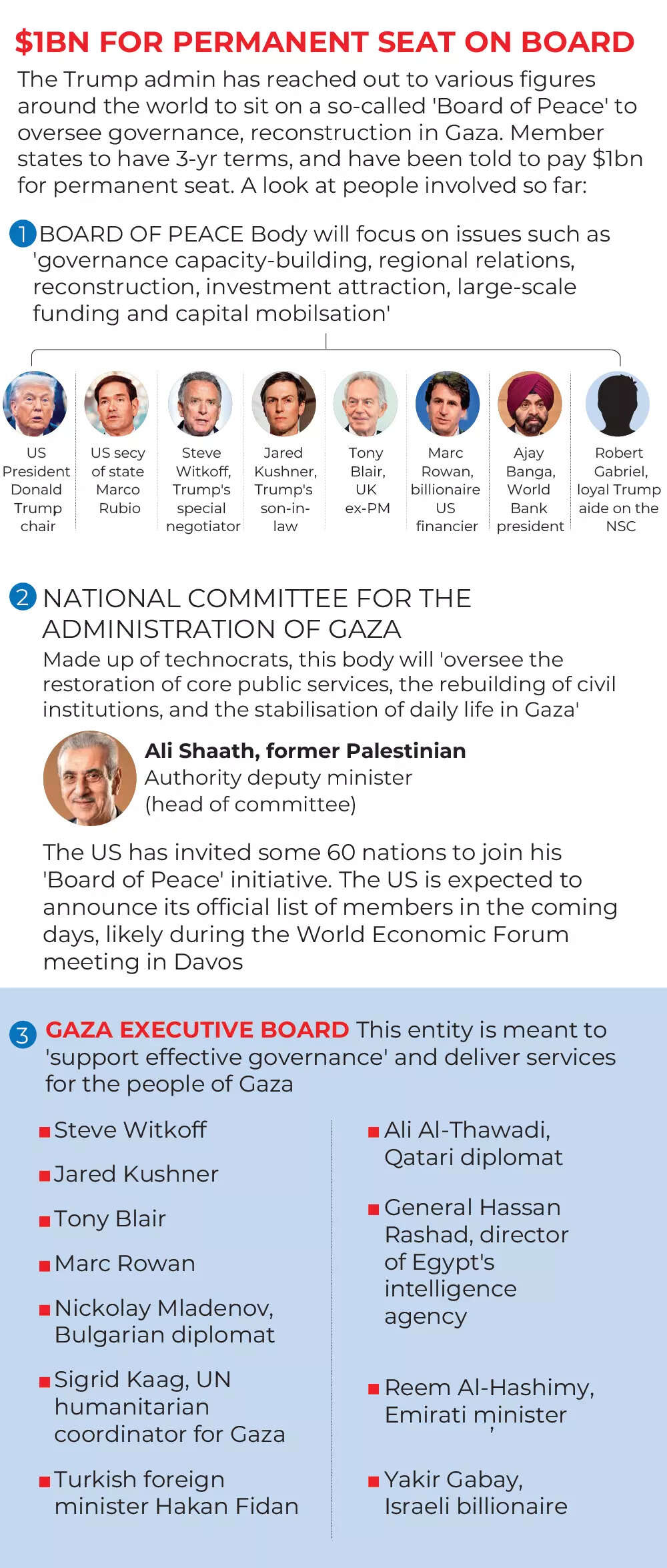
The $1 billion ‘Board of Peace’
The idea was formalised on September 29 2025 in a 20-point plan for redevelopment under a US-chaired Board of Peace, which took concrete form on 15 January 2026 when Trump unveiled the Gaza Peace Board. The $1 billion reconstruction plan focuses on housing, power, water, sanitation, and jobs, with funding linked to security and regional cooperation.The Executive Board, announced on January 17, brings together diplomats, politicians, and financiers, including Nickolay Mladenov as High Representative for Gaza, US secretary of state Marco Rubio, Middle East envoy Steve Witkoff, Jared Kushner, former UK PM Tony Blair, Apollo Global Management chief Marc Rowan, World Bank president Ajay Banga, and political adviser Robert Gabriel Jr.Invitations for founding membership span multiple regions: Egypt, Jordan, Turkey, Qatar, the UAE, and Morocco; Argentina, Canada, Brazil, and Paraguay; India, Pakistan, Vietnam, Australia, and Indonesia; and European nations including France, Germany, and the UK.