
97 million-year-old fossils suggest early animals navigated using Earth’s magnetic field |
Something unusual keeps turning up in marine sediments. These are large crystals of magnetite, formed by biology rather than geology, and preserved for tens of millions of years. Known as giant magnetofossils, they are far bigger than the magnetic particles made by bacteria today, often reaching several microns in size. They appear in rocks dating back at least 97 million years, across different climates and oceans. Their shapes are precise, repeated, and difficult to explain without biological control. Yet the organism that made them has never been identified. Until now, their purpose has mostly been assumed rather than tested. New magnetic imaging work suggests these crystals may have been used to sense Earth’s magnetic field, not simply as physical armour.
Scientists uncover fossils that behave like ancient biological compasses
Giant magnetofossils come in several recognisable forms. Researchers have described needles, bullets, spindles and spearhead shapes, all made of nearly pure magnetite. Their chemistry, crystal structure and consistent proportions point to controlled growth inside living organisms. Because they are much larger than bacterial magnetite particles, they are generally thought to have been made by eukaryotes, possibly single-celled or simple animals.Earlier ideas focused on mechanical use. Sharp spearhead-like crystals clustered together were interpreted as defensive spines in soft-bodied creatures living in mud. Similar mineral structures are known in modern animals, such as iron-rich spicules or hardened teeth. But clusters of giant magnetofossils are rarely found, and many shapes do not fit a clear protective role.
Magnetic imaging reveals a single vortex state
The study “Magnetic vector tomography reveals giant magnetofossils are optimised for magnetointensity reception” used advanced soft X-ray magnetic vector tomography to look inside a single giant spearhead magnetofossil from sediments about 56 million years old. The technique allows researchers to map magnetisation in three dimensions without cutting the sample.What they found was not a uniform magnet, instead of behaving like a solid bar magnet, the crystal contains a single swirling magnetic pattern. The magnetism loops around inside it, forming a kind of magnetic whirl that runs through the length of the fossil. This pattern is orderly and stable, not messy or chaotic.That matters because large magnetic crystals usually break into many competing magnetic regions, which makes their behaviour unpredictable. This one does not. Its magnetic direction stays mostly aligned with the long shape of the crystal. Computer models show the same behaviour, suggesting this structure is not an accident or the result of damage. It looks like something shaped to work a certain way.
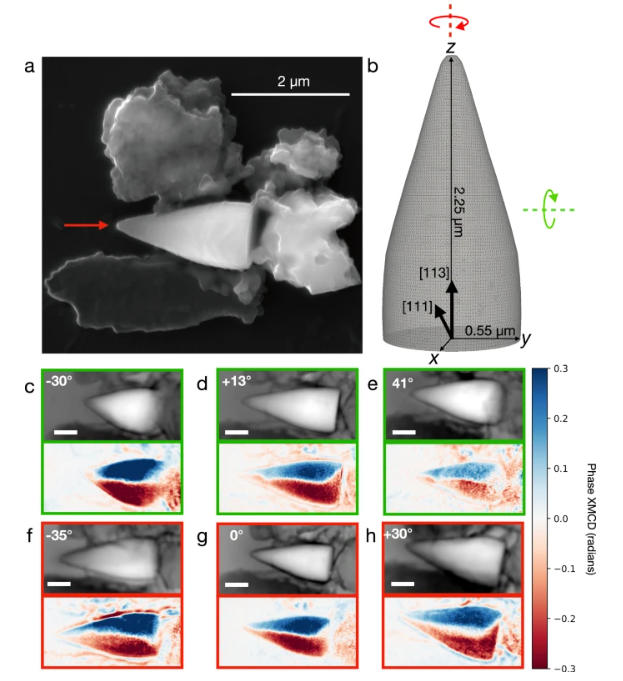
2D microscopic and magnetic characterisation of a giant spearhead magnetofossil (Image Source – Communications Earth & Environment)
Size limits hint at biological optimisation
When scientists looked at many other giant magnetofossils, they noticed something striking. Most of them fall within a narrow size range where magnetic sensitivity is high but stability is still preserved.If the crystals grew much larger, their magnetic structure would become complicated and unreliable. If they were smaller, they would be less sensitive. The fact that most fossils sit in this “sweet spot” suggests their size was not random.This may explain why giant magnetofossils rarely grow beyond a few microns. Their dimensions appear tuned to maintain a simple, stable magnetic pattern. In other words, their shape and size look chosen by evolution, not produced without limits.
Implications for early animal navigation
If these crystals were used to sense Earth’s magnetic field, they change the timeline of when this ability first appeared. They suggest that ancient marine animals may have been able to detect and use Earth’s magnetic field tens of millions of years earlier than previously confirmed.The discovery also has wider importance. Magnetite is one of the key minerals scientists look for when searching for ancient life on Mars. Understanding how living organisms shape magnetic minerals, both externally and internally, helps distinguish biological signals from purely geological ones.These fossils hint that the rock record may still contain quiet clues about ancient senses that modern animals now take for granted.